YOUTH PLACED AT RISK: NPR OPIOID CRISIS EXPERT SOURCES HELP HIDE THE OBVIOUS MEANING OF PREDICTABLE, LETHAL TRENDS
Additional consistent evidence that drops in fatal opioid overdoses are entirely due to naloxone campaigns must be mystified to cover up gold standard treatment failure
by Clark Miller
Published August 7, 2026
Headlines can be lies, and lies can be lethal.
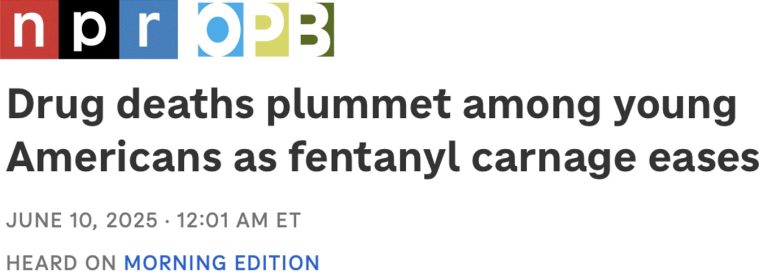
“What we’re seeing is a massive reduction in [fatal] overdose risk, among Gen Z in particular,” said Nabarun Dasgupta, an addiction researcher at the University of North Carolina. “Ages 20 to 29 lowered the risk by 47%, cut it right in half.” …
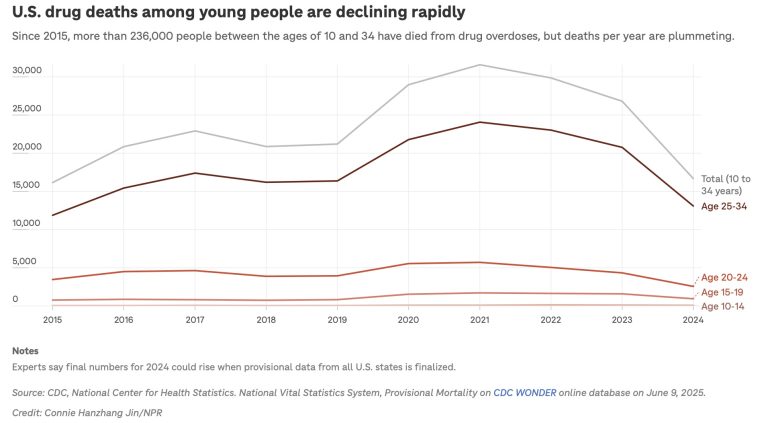
Especially among teenagers in the U.S., fentanyl deaths seemed stuck at catastrophic levels, between 1,500 and 2,000 fatal overdoses a year. Then last year, federal data revealed a stunning decline, with 40% fewer teens experiencing fatal overdoses. “We’re super heartened to finally see teens dropping,” Epstein said.
While the improvement is dramatic, Dasgupta at the University of North Carolina, found the recovery among teens appears uneven.
Some teens and 20-somethings are seeing far fewer deaths, but he identified one cluster born between 2005 and 2011 who actually saw a slight uptick in deaths over the past two years. The increase is relatively small — about 300 additional fatalities nationwide over two years — but Dasgupta said it’s an area of concern that needs more study to determine why.
[emphasis added]
Can no one do math anymore?
A couple of extremely salient points.
1.
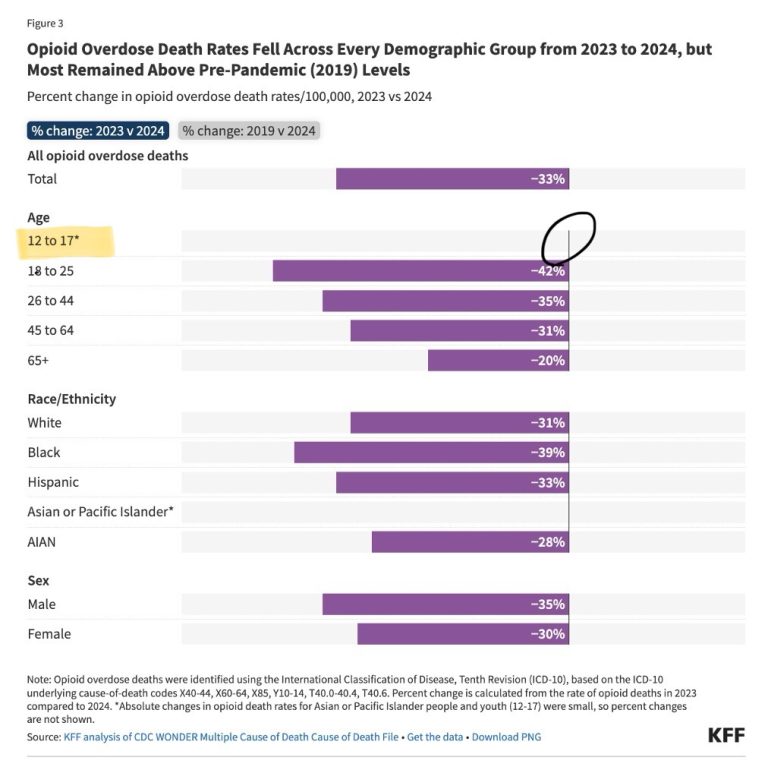
That “cluster born between 2005 and 2011” with opioid overdose deaths increasing? They would have been (if I can do math) ages 13 to 19 in 2024, the year of notable declines for later ages.
That difference is sharpened in focus by a graphic from a KFF report.
So, it’s not at all the case that “teen” opioid overdose deaths dropped over that perioid, in fact may have increased. And because “Gen Z” is defined as individuals who would have been between ages of 12 and 27 in 2024, it’s also a gross distortion – and lethal lie as we’ll soon see – to convey that deaths for Gen Z or for “young Americans” plummeted dramatically, when roughly the lower half of that age group experienced no decrease or an increase in deaths.
2.
In that first paragraph of the excerpt above from the NPR piece, please note the “[fatal]” added not by me, but apparently by an NPR editor.
In thinking about and making sense of lethal opioid crisis trends, there may be no more critically important and fundamental distinction than between fatal and nonfatal overdoses.
Very briefly and as repeatedly described in many posts for readers here and here, for example, here, decreases in fatal opioid overdoses are not a measure of a moderating or improving crisis because, from the start, that measure has always been confounded by the emergency use of naloxone to reverse potentially fatal overdoses, representing instances of high-risk use = treatment failure in a worsening crisis.
Nonfatal overdoses – representing high-risk opioid use – are as such a measure of the status of the crisis, worsening or improving, with a critically important qualification – that over recent years, with intensive, community-based naloxone campaigns shifting reversals to community, peer, and layperson saves that are not reported, prevalence of high-risk use and overdose is predictably underestimated.
What we are compelled to observe and conclude is the obvious – that over the period of interest, opioid overdose deaths declined markedly for young adults, in sharp contrast to no change or increase for young persons of middle school and high school ages.
And that from the data discussed so far, we have no gounds to dismiss, for any of those age groups, that high-risk opioid use – measuring the severity of the crisis – was not increasing. Instead, the desperate need for emergent, intensive, dramatically expanding naloxone campaigns to moderate deaths, along with other valid evidence, points directly to persistently increasing high-risk opioid use.
A no less salient point is that the designated top expert relied on by NPR for expertise and guidance was from all indications not cognizant of the fundamental distinction between fatal and nonfatal overdoses, required to make sense of trends and needed direction in addressing the lethal crisis, hence the editorial correction of “[fatal]”.
There are no surprises here, no mysteries,
no need to scramble for answers, already apparent. We’ll see why soon, after running through the expert theories.
Again from the NPR report –
The question now is what changed that is suddenly saving so many young lives? Drug policy experts are scrambling to understand the shift.
Many U.S. kids appear more cautious about drug use
Theories include the wider distribution of Narcan, or naloxone; a trend of weaker, less deadly fentanyl being sold by dealers; more readily available addiction healthcare; and also the loss of so many vulnerable young people who have already died.
Many researchers believe another key factor may be less risky drug and alcohol use among teens and twenty-somethings, a pattern that emerged during the years of the COVID epidemic. One study by a team at the University of Michigan found the number of teens abstaining from substance grew to its highest level in 2024.
“This trend in the reduction of substance use among teenagers is unprecedented,” Nora D. Volkow, who has served as director of the U.S. government’s National Institute on Drug Abuse since 2003, said in a statement last December.
Keith Humphreys, an addiction researcher at Stanford University, credits this apparent behavioral shift with helping save lives. “There’s fewer people initiating with these substances. That should work in our favor,” he told NPR.
According to Dasgupta at the University of North Carolina, years of devastation caused by fentanyl and other opioids might mean more people in their teens and twenties are choosing to experiment with less risky drugs.
“Alcohol and opioids are on the outs with Gen Z, and instead we see [a shift to] cannabis and psychedelics, and those are inherently safer drugs,” he said.
“Theories include the wider distribution of Narcan, or naloxone”
That is, in fact, not a theory; instead, naloxone campaigns are established as consistently more than accounting for the magnitudes of all drops over the past years in opioid overdose deaths.
In distinct contrast to the following expert conjectures that are entirely speculative, each incidence of observed naloxone application constitutes direct evidence of an overdose death prevented.
“a trend of weaker, less deadly fentanyl being sold by dealers”
There is no evidence to support that this or any other supply disruptions or changes have resulted in reduced overdose deaths. For these to have that effect requires that they are associated with decreases in high-risk use and overdose, which are increasing, driving the desperate need over past years for the emergency, intensive naloxone campaigns.
“more readily available addiction healthcare“
If this factor has suddenly had the speculated effects over the past two years, why have persistent increases in treatment availability over past decades never yet before provided that benefit, as crises worsened? And how to explain overdose death reductions from “treatment” models established as providing no benefit.
“the loss of so many vulnerable young people who have already died“
For this to be a factor requires that high-risk opioid use and overdose have decreased for this age group, and there is no evidence for that, instead for increasing high-risk use.
“Many researchers believe another key factor may be less risky drug and alcohol use among teens and twenty-somethings, a pattern that emerged during the years of the COVID epidemic. One study by a team at the University of Michigan found the number of teens abstaining from substance grew to its highest level in 2024.”
Do we need to remind ourselves that the question we are considering is how to understand the significant drop in opioid overdose deaths for this age group? From that linked-to study –
“Abstention” from drug use is defined here as no past 30-day use of alcohol, marijuana, or nicotine by vaping or by cigarettes. Abstention levels in 2024 were at the highest recorded by the survey since it first started tracking this outcome in 2017.
Surprised?
“This trend in the reduction of substance use among teenagers is unprecedented,” Nora D. Volkow, who has served as director of the U.S. government’s National Institute on Drug Abuse since 2003, said in a statement last December.
Those invalidated results and conclusions are addressed here and here and here.
Surprised?
Keith Humphreys, an addiction researcher at Stanford University, credits this apparent behavioral shift with helping save lives. “There’s fewer people initiating with these substances. That should work in our favor,” he told NPR.
See above.
[Here’s how one report noted these rather bold discrepancies provided by America’s top experts:
National survey data show that while the percent of adolescents (ages 12-17) with a past year substance use disorder decreased from 2021 to 2024, the share of adolescents with a past year opioid use disorder remained stable over the same period. Additionally, less than one-third of adolescents with a past year opioid use disorder reported receiving any treatment.
An important qualifier needs to be added here. As described and explained here, those national surveys excluded the large group of adolescents most likely to be engaged in high-risk substance use – the millions of kids who disengaged from public schools over COVID shutdowns and did not return, never surveyed.]
According to Dasgupta at the University of North Carolina, years of devastation caused by fentanyl and other opioids might mean more people in their teens and twenties are choosing to experiment with less risky drugs.
The speculation that young people traumatized by their experiences in opioid-abusing households and communities and have been “scared straight” or “scared safe” is invalidated here and would require evidence that high-risk opioid use has decreased for that group. It is established that those experiences instead drive heightened vulnerability to compulsive use of substances to moderate inner distress.
So, that’s that, and we can get around to stating the obvious.
The dramatically effective, near-universal, directly-evidenced, community-based naloxone campaigns that are established as more than accounting for all observed drops in opioid overdose deaths – the state and locale apparent exceptions proving that rule – have remarkably dropped opioid overdose deaths across all demographic groups.
Except for one age group, the group at high risk of high-risk use and overdose, and that has been almost without exception disallowed from possessing and carrying Narcan and rarely trained on its use, precluding the established, critically important life-saving benefits of peers, proximate to each other, responding quickly to potentially fatal overdoses to reverse them, when seconds count – middle and high school-aged kids. That is the one demographic standing out as missing out on the trend of reduced deaths.
How do we know that?
We know from a large, easily accessible body of reports and evidence.
Let’s outline that.
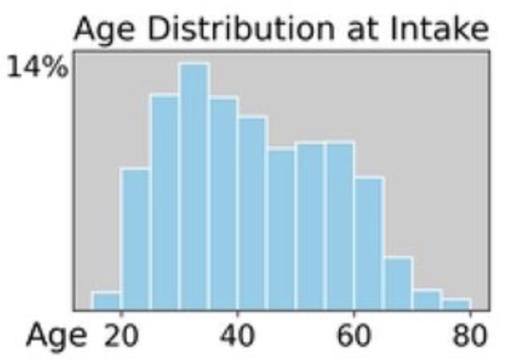
Beginning with an indication in this pre-publication of adolescent involvement in community naloxone campaigns that included training and provision of Narcan units in Pittsburgh, Pennsylvania, over the period July 2005 to January 2023.
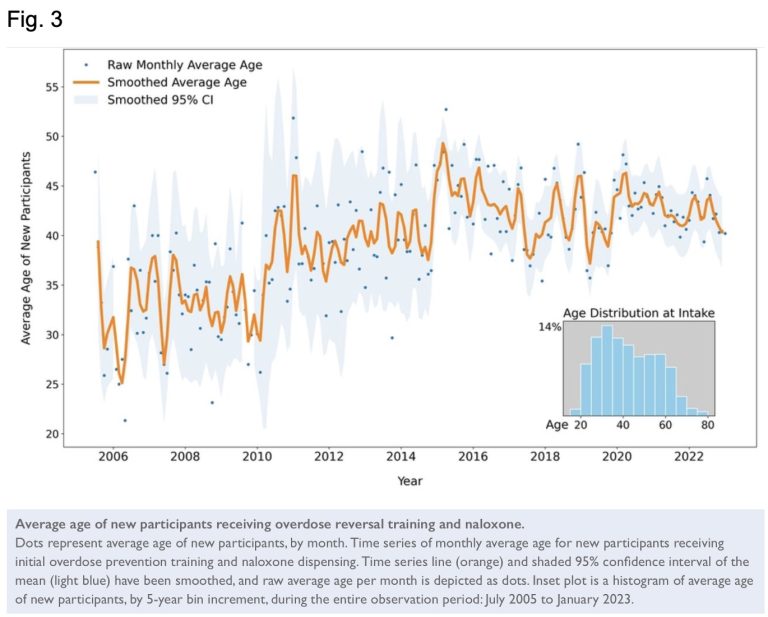
Noting the inset bar graph, that’s a very low uptake for the middle- and high-school age group.
That’s for a community, so let’s turn to schools, with a clearly much greater potential to provide training and Narcan to a “captive audience”.
But, critically and important to remember, not to the excluded audience at highest risk – those millions of students known to be at higher risk of problem substance use and who, in response to the dysfunction of COVID shutdowns, left school enrollment and did not return.
From a KFF report, representing nationwide data over 2024 to 2025 –
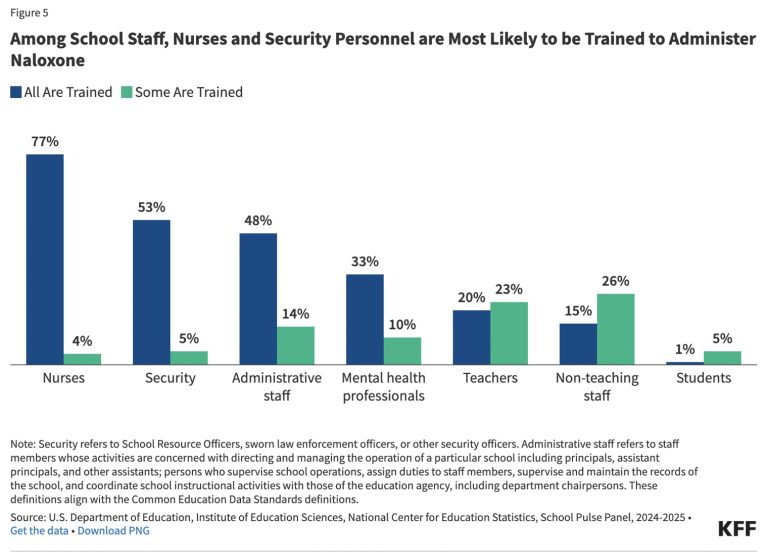
That tells us something doesn’t it?
Let’s consider California and its Los Angeles school district, the 2nd largest in the country, a state in which, explained in detail here, opioid overdose deaths dropped dramatically after – and entirely attributable to – extensive, successful naloxone campaigns resulted in more than 8 million Narcan kits distributed and an estimated half million and counting opioid overdose deaths have been prevented.
A state also in which legislation requires naloxone training and distribution at state colleges and in which the governor included funding in the state budget to train for and provide naloxone to high school students, reported here in early 2023.
And in those high schools, for our adolescent age group?
Barriers remained, including –
With overdoses near record highs because of the prevalence of fentanyl, Gov. Gavin Newsom called in his recent budget proposal for $3.5 million to supply middle and high schools with naloxone — even as a potential deficit looms and some programs face cuts. …
“If you have free, ready access to something like this, why not put it in those spaces where you could save a life?” asked Flores.
But many districts don’t carry it in the absence of a state mandate. And despite Newsom’s support for more naloxone funding, he has not said whether he backs legislation that would require schools to keep the antidote drug on site.
Keeping a couple doses in a central location within a school is only the “bare minimum thing that we should do,” said Shover.
Teenagers are more likely than school nurses to see their peers overdosing in time to do something about it, and those whose friends might be at risk should carry doses, the epidemiologist said …
From a 2024 overview of those goals by END OVERDOSE, a primary nonprofit organization in California distributing naloxone –

One of the main barriers to implementing the pilot program was school district policies that restrict students from carrying medications on campus, which limits access to this potentially life-saving resource. In SCUSD, while naloxone and test strips were distributed to students with approval from the district, a policy classifying naloxone as a medication prevented students from actually carrying it on campus. These challenges were encountered in multiple school districts, including some in Los Angeles County, where the distribution of fentanyl test strips and naloxone was not approved.
[SCUSD = Santa Clara Unified School District]
A more recent summary, published in the American Journal of Public Health in December 2024, addresses continuing needs and barriers for efforts to place naloxone in the hands of adolescents trained to use it.
An efficacious prevention strategy would universally teach individuals how to recognize and respond to an overdose with naloxone administration, which is foundational to opioid overdose response. … However, adult-focused implementation strategies to improve access to naloxone are not reaching youths. Per capita dispensing of naloxone remains lowest among those aged birth to 19 years,8 and a review of Centers for Disease Control and Prevention 2019–2021 data found that naloxone was not administered in 70% of fatal overdoses in those aged 10 to 19 years despite the presence of a potential bystander in 67% of the cases.4 …
Overdose deaths are preventable when youths can access naloxone and overdose prevention education that is evidence-based and acceptable to youths. Yet public health efforts to expand naloxone access focused on adults and patients with a history of opioid use have not addressed gaps in provider knowledge, pharmacy access, and understanding of overdose risk factors that limit youth access. There is a desperate need for new public health strategies targeting youths to prevent further adolescent deaths.
Rolling Stone magazine gets it.
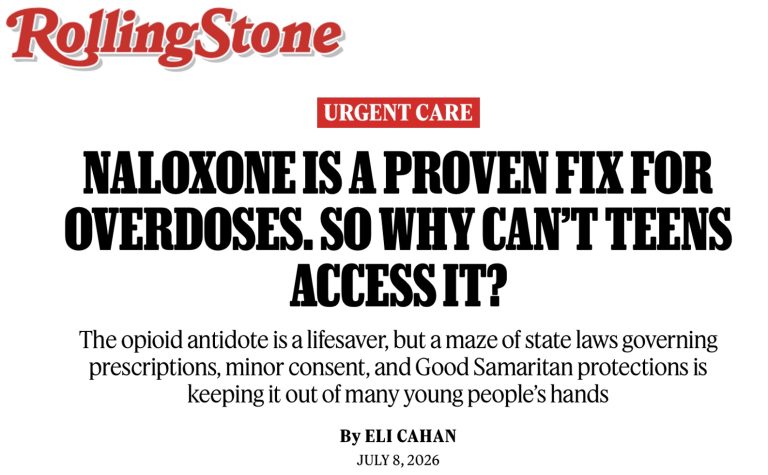
The picture is clear – it’s the naloxone
It’s the naloxone, or lack of provision and training for its use, that has explained and accounted for the entirety of magnitudes, patterns, and differences in decreases in opioid overdose deaths among states and locales, and in this case, among demographic groups, with very unfortunate outcomes.
So, the “lethal lie” alluded to early in this post describes more than the malignant neglect of a desperate need for teens and adolescents to be equipped with and trained how to use naloxone, resulting in their being left out of significant Narcan-provided opioid overdose moderation experienced by all older groups in recent years.
The lie is deeper, much more extensive, and more desperately hidden. And yet exposed directly by congruent and consistent lines of evidence and outcomes for years and longer –
By all valid measures, the opioid crisis as we see it has persistently worsened and continues to worsen, with unabated and increasing high-risk opioid use and overdoses that are grossly under-measured.
Increasingly intensive, desperate, emergency reversals of otherwise fatal opioid overdoses by use of naloxone – a clear, direct measure of high-risk use – more than accounts for all reductions in fatal overdoses, the diversionary, expert-fabricated, evidence-free, and thought-free rationalizations nullified and invalidated as they arise.
Naloxone, as directly observed and evidenced, acts only after high-risk use has occurred to prevent overdose fatalities. All other “treatments” and interventions, including “harm-reduction” and interdiction, conversely can provide benefit only by reducing high-risk use to begin with, high-risk use that is increasing.
That is to say, the decades of substance use and opioid crisis approaches from American Medicine, Behavioral Health, and Public Health are established as lethal failures, predictably, as instead fueling lethal crises, as evidenced, for example, incontrovertibly in a largest-ever $344 million NIH study in natural treatment environments.
While major media, in their failed role as watchdogs, celebrate fabricated gains and help generate mystification of cause and effect.
Surprised?