FROM RHODE ISLAND, ANOTHER REMINDER OF A WORSENING IATROGENIC OPIOID CRISIS
In Rhode Island, and everywhere, opposing trends of mounting high-risk opioid use and overdose against sudden declines in fatal ODs can only mean one thing – lethal failure of expert gold standard treatments
by Clark Miller
Published October 9, 2026
We considered the situation in Rhode Island briefly in this post, and the grim, clear import of the evidence there compels us to ensure accurate exposure, to guard against lethal mystification and benighted, useful fictions.

“The Rhode Island Department of Health (RIDOH)is alerting the public to an increase in non-fatal drug overdoses between March 10, 2026, and March 16, 2026. During this time, there were 55 reports of people receiving care at emergency departments for suspected drug overdoses. In 2026, Rhode Island has had an average of 41 non-fatal overdoses a week.
RIDOH’s Overdose Spike Alert System (OSAS)tracks weekly non-fatal drug overdose activity across Rhode Island. Through the system, RIDOH has weekly overdose thresholds set for 11 regions throughout the state and the state as a whole. The 55 overdoses over the past week met the 55-overdose threshold for the state. Additionally, Region 1(Burrillville, Foster, Glocester, and Scituate) exceeded its threshold for suspected non-fatal drug overdoses for this same week, and for the prior week.“
This comes at a time when overdose fatalities have decreased by about 33% in a year-over-year comparison.
[emphasis added]
In that report, the increased overdoses are attributed primarily to fentanyl.
It’s important to remember that non-fatal opioid overdoses measured by ED and/or emergency responder logs and reports are increasingly established as gross underestimates tied to major shifts increasing prevalence of unreported, layperson community reversals that do not become part of an available record. Those increasing unreported reversals (= instances of high-risk opioid use) occur due to dramatic expansion and effectiveness of community-based naloxone campaigns, described in multiple posts, for example, here and here.
Intensive, successful naloxone campaigns like that described in this July 2024 report for Rhode Island directly antecedent to the large drops in deaths.
“We are working in every city and town in Rhode Island to make life-saving resources available in the areas of prevention, treatment, harm reduction, rescue, and recovery,” Dr. Jerry Larkin, the state’s new health director, said in a statement. “Every single overdose death is preventable. Recovery is within reach for every person living with the disease of addiction. We need to keep coming together as families, as communities, and as a state to continue reducing the number of drug overdose deaths in Rhode Island.”
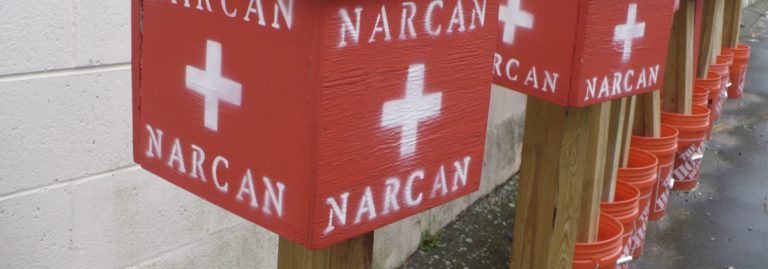
The decline in fatal overdoses follows increases in the availability of the opioid overdose reversal medication naloxone, known as Narcan. In Rhode Island, naloxone is distributed by nonprofit groups at homeless encampments and in Kennedy Plaza in Providence. And last March, Narcan became available for purchase over-the-counter at pharmacies nationwide.
[emphasis added]
The importance of all of this – and especially of thinking about it – is of course in understanding the true nature of the genesis, course, and persistence of America’s worsening, iatrogenic opioid crisis.
That understanding is laid out here, as in additional posts, and in more explicit detail in this recent post.
From that post –
But how can that make sense?
Digression:
There is just one way, one way only, that naloxone (Narcan) can be effective to reduce opioid overdose deaths, and that is after a potentially fatal opioid overdose has occurred. At that point, it becomes remarkably effective, preventing, in a matter of minutes, an opioid overdose death from occurring.
All other conjectured factors employed to mystify recent, nationwide decreases in opioid deaths, including gold standard treatments and “supply shock” and other disruptions in availability or potency of drugs of abuse, are nearly the opposite in how – by the only possible means – they can have effects.
Clearly, not in the minutes after a potentially fatal opioid OD has occurred, but only by preventing those potentially fatal overdoses, meaning only by preventing high-risk opioid use.
So far so good?
So, how can that possibly make sense?
Make sense that high-risk users in Pittsburgh remained at high risk of opioid – fentanyl! – overdose and potentially death, while at the same time, variations in the street illicit opioid economy were leading to dramatic drops in fatal ODs? Which would, necessarily, have had to have been due to significant reductions in the behaviors of high-risk users, prevention of high-risk use in large numbers of high-risk users.
And? over the period of interest, while fentanyl, along with all kinds of other illicit and prescribed opioids and adulterants, were still there, available on the street to anyone determined to get them. Almost certainly, users encountered and experienced those variations in their daily use, and yet opioid overdose deaths dropped dramatically.
The interviewed social services worker was, of course, right, the danger wasn’t over, because there was no disruption of the desperate, driven need to use an unpredictable drug supply to gain relief from the overwhelmingly powerful inner states and drives that compel high-risk users to keep using, at high risk.
See how we did that? All it took was a few moments of thought, of healthy curiosity, of questioning.
…
Reality check and reminder: for expert gold standard treatments, fentanyl test strips, illicit drug interdiction, or any form of supply variation to possibly be credited with a role in reducing opioid deaths, their implementation must reduce high-risk opioid use and overdose. Must.
In contrast, if high-risk use and opioid overdose are increasing, while opioid fatal overdose rates are moderated or reduced, that can only mean one thing – that naloxone campaigns are the cause of reduced deaths.
Although that question is answered for our example of Allegheny County, PA, the picture clear from available reports, we fortunately also have direct evidence, and that evidence happens to rule out all factors other than naloxone.
Back to our current post.
It’s well worth reading the entirety of the post just excerpted from, for the examples of evidence from other locales reinforcing, by replication of factors and effects, the established picture we see in Rhode Island as well.
That picture is of medical gold standard treatments, street drug supply variations, other interventions and harm reduction services, all ruled out as having significant roles in recent reductions in opioid deaths, because they can only have that effect by reducing high-risk use, incongruent with high-risk use increasing.
It’s the naloxone and desperate, intensive, emergency naloxone campaigns whose necessity is generated precisely due to the established lethal failure of decades of increasingly provided expert gold standard “treatments”.
No mystification can erase that.
That’s the takeaway, that reminder.
And notice.