THE NEWEST MEDICAL TRAP FOR A NON-MEDICAL CONDITION: GLP-1 DRUGS
Opioids to treat psychogenic pain, other opioids to treat opioid abuse, vapes for cigarettes, GLP-1s for compulsive stress eating, and the only escape lies within
by Clark Miller
Published October 24, 2026
Compulsive substance use driven by poorly tolerated, unrelieved inner states, or “stress“, is the cause of childhood and adult obesity, no differently when the substance is food than when it is alcohol or methamphetamine or fentanyl, those substances predicting different types of physical, emotional, and mental harms from persistent use.
The equivalences among substances of abuse in user behaviors, psychological drivers, role of stressors and other environmental and intrapsychic activators, as well as diagnostic and clinical formulation, have been apparent for a long time.
But you wouldn’t know it.
You wouldn’t know it for the freakishly successful fabrications of America’s medical/public health/media collusion that has, remarkably, succeeded in constructing conditions as overtly non-medical as “addiction“, chronic pain, and depression as, somehow, medical conditions, as absurd and lethal as those fabrications have been.
So, of course, it has been predictable and inevitable, not just that those lies would generate worsening opioid and other substance use crises, not just epidemics of chronic pain and of depression that go untreated, but a latent public health disaster for what was promised as a cure and is now clearly a medical trap for users of GLP-1 medical cures for obesity. Like this medical/public health trap.
As conveyed succintly in this recent report,
Appetite suppression and craving are not the same clinical phenomenon. GLP-1 medications reduce physical hunger signaling. They do not inherently address why someone eats when they’re not physically hungry. That’s craving — a separate mechanism driven by reward, habit, and stress rather than gastric signaling.
[emphasis added]
Yes, that’s right, ultimately and causally most deeply, compulsive use of food driving obesity and associated problems is itself driven by psychological factors for which there are no medical interventions, no more than there are for other substances.
That is, “addiction medicine” and other forms of medical model scope of practice assaults on non-medical problems were predictably doomed to generate harm and fuel epidemics before ever conceptualized.
Short version –
While GLP-1 medications reduce weight and improve blood sugar regulation and associated measures and risks, additional, perhaps expected, gains in mental health, mood, and functioning are not being detected. And, uncontroversially, the physical and metabolic benefits disappear after cessation of the medication.
Is it a good idea to stay on GLP-1s indefinitely? The research does not answer that, with evidence for reasons for concern. Sarcopenia risk, for example, is debated, and yet articles like this are not a promising sign –
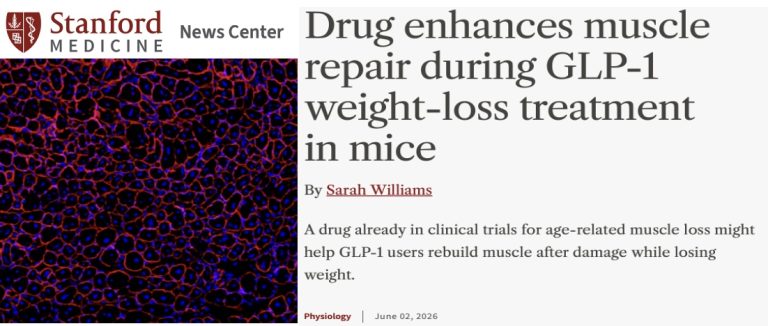
The risks of persistent use are yet unknown, as exponential growth of use of the medical cure traps more and more in dependence on such use, or to face loss of gains and associated costs.
Kids are generally more vulnerable to malpractice than adults, and – you guessed it – GLP-1s are increasingly being provided to them as prescribed by medical professionals and off-label, despite warnings.
The anomalously cogent, clinically and ethically informed and competent take by a rogue medical professional on the question is, predictably, relegated to a “second opinion” piece.

And there’s this, from a “triple board-certified obesity medicine physician” –
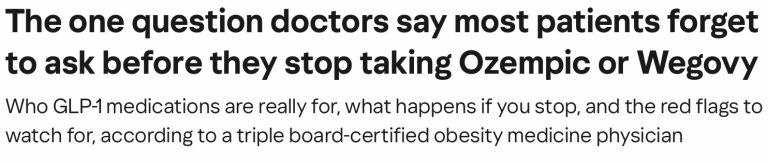
The one question patients forget to ask: what happens if I stop?
“Many patients forget to ask, what happens if I stop taking the medication?” Dr. Tosin shared. The honest answer surprises a lot of people. “Studies show that most people regain much of the weight they lost after stopping a GLP-1 medicine,” she said, adding that blood sugar, blood pressure, and cholesterol levels can drift back up too
The data backs her up. In the STEP 1 trial extension, participants regained roughly two-thirds of their lost weight in the year after stopping semaglutide, with cardiometabolic improvements largely reverting toward baseline. A broader systematic review and meta-analysis found a similar rebound pattern after discontinuation.
“GLP-1 medicines are often seen as a long-term treatment for chronic diseases,” she explained, so it’s worth asking yourself honestly whether you’re ready for that commitment, paired with sustainable lifestyle changes.
[emphasis added]
Let’s think about that for a bit, this part: “patients forgot to ask”.
Patients should never have to ask that question, because for any competently practicing professional, that effect, along with other possible drawbacks to use of the medications, would have come up very early in the provider’s initial discussion of the drug, under informed consent, for all healthcare providers among the most fundamental of their ethical duties and standards of practice – to provide explanations of risks, benefits, and alternatives for any recommended or provided medical procedure or prescription.
Failing to provide that type of informed consent in any initial discussion of patient use of a GLP-1 would be like … like failing to inform patients of the potential in their use of prescribed opioids for dependence, illness and death if misused.
While medically prescribed GLP-1s take their predictable course in public health and the lives of individuals prescribed them, they are being celebrated by the usual suspects as game-changing, potentially miracle cure-alls, the reports benefiting from useful idiocy.
In a major media report that asserts this absurdity, that “what GLP-1 drugs appear to do — prevent risk of addiction more generally”, … an expert offers qualifications and assurances:
It’s also unclear how long people with substance use disorder would need to take a GLP-1 drug.
“My hope is that we’ll figure out ways that a young person won’t have to be on a medication for the rest of their lives,” Klein says.”
Indeed. Unlike the “miracle molecule” methadone, or the gold-standard life-saving medication buprenorphine.
Something we can be certain of: that GLP-1 drugs will be every bit as game-changing as have been existing expert medical cures for the non-medical condition of compulsive substance use.