IN MICHIGAN, A REALITY CHECK FOR OPIOID CRISIS EXPERT MISINFORMATION
The numbers don’t lie – each naloxone reversal of an otherwise fatal opioid overdose is a reduced death and an instance of high-risk use representing treatment and prevention failure
by Clark Miller
Published October 2, 2026
A new report at Mlive.com, providing data from the Michigan Department of Health and Human Services (MDDHS), dispels the persistent fictions that Michigan’s public health, state, and expert sources have fabricated over past years to attempt to hide the lethal failure of expert approaches, that failure necessitating desperate, intensive naloxone campaigns as harm reduction.
And the article’s selected feature image tells the story.
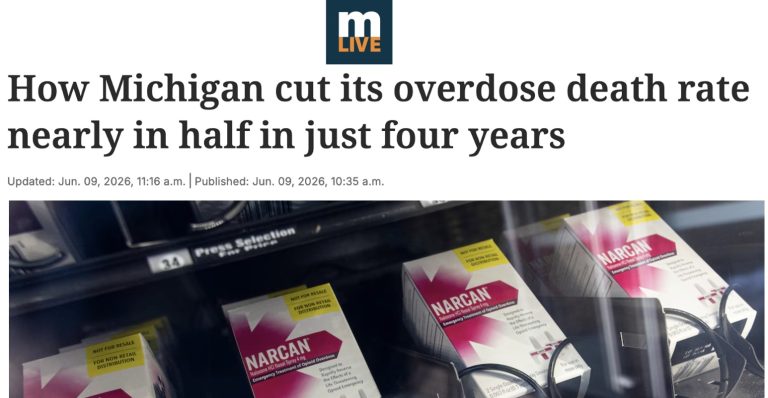
The decrease from 3,096 drug deaths in 2021 to fewer than 1,800 last year represents the “impact of sustained, data-driven investments of opioid settlement dollars across Michigan,” according to Elizabeth Hertel, the department’s director.
“MDHHS remains committed to continuing programs and partnerships that help reduce overdose deaths, expand treatment options and support long-term recovery,” Hertel said via a prepared statement. …
Health officials credit the strategies of prevention, harm reduction, treatment and recovery services for the measurable decline in overdose deaths. That includes expanding access to naloxone, a lifesaving nasal spray that restores breathing by blocking the effects of opioids on the brain during an overdose.
Since 2020, more than 1.8 million naloxone kits have been distributed statewide with nearly 34,000 reported uses to reverse overdoses and help save lives. Without naloxone distribution, the state estimates there would have been 2,089 additional deaths in 2023 and another 1,934 in 2024.
[emphasis added]
Let’s do the numbers.
It is clear – established by consistent reports of community direct-service providers and others across U.S. states and diverse locales – that the “nearly 34,000 reported uses to reverse overdoses” is a significant underestimate, because as intensive naloxone campaigns have shifted reversals to street- and community-level settings, situations often with strong disincentives to contact emergency services or otherwise formally report an overdose, many more opioid overdoses are NOT reported.
From 3,096 deaths in 2021 to 1,800 in 2025 appears to be a decrease of about 1,300 deaths, about 425 fewer per year if those decreases were evenly distributed.
And, for two of those years, “the state estimates there would have been 2,089 additional deaths in 2023 and another 1,934 in 2024″ without naloxone distribution.
Think about that, and let’s review 4 previous posts here at ACD that have looked at Michigan’s response to opioid crisis high-risk use, overdose, and deaths, bearing on persistent claims that “prevention, harm reduction, treatment and recovery services” have had some positive, protective effects, beginning with a post originally published June 2019.
We saw in that post that in Michigan, as consistently in other states and locales (separate posts linked to), opioid -related deaths persistently surged at the same time that provision of expert, gold standard treatments was being expanded. The reasons those have been predictable outcomes were discussed.
In a November 2024 post, we looked at how Michigan’s course of stepping up naloxone provision more than accounted for year-by-year decreases in overdose deaths.
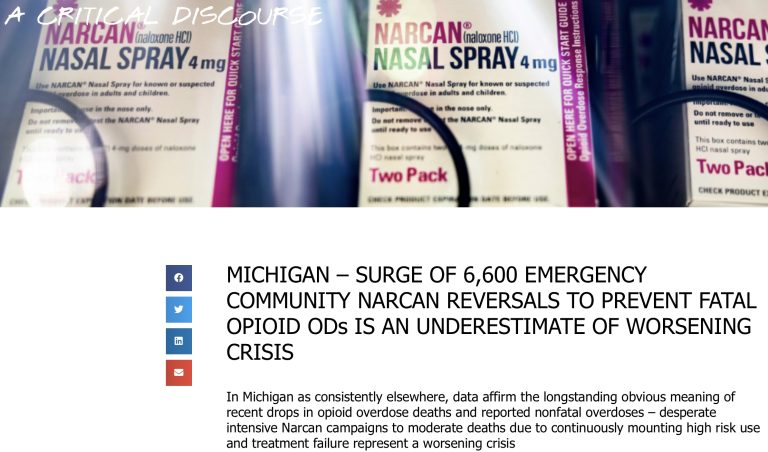
An August 2025 post arose from a compelling need to correct evidence-free claims of benefit and contribution to opioid OD death reductions from the failed programs and approaches whose failure had been driving high-risk use and overdose over decades, until intensive, targeted naloxone campaigns began reversing the otherwise fatal ODs generated.
Those credited approaches included “prevention, treatment, recovery, and harm-reduction efforts“, also “expansion of medication assisted treatment in jails … peer-recovery coaches [who] offer help to users … drug test strips“.
They were invalidated in that post, and in more recent posts here (for prison-based medication treatment), here (for fentanyl test strips), and here (for related expert explanations of opioid death drops).
The distortions, fabrications, and “MISINFORMATION” by the Michigan Department of Health & Human Services (MDHHS) outlined in this November 2025 post attempt to attribute opioid use health measure changes to gains due to broad, general, and various elements of “our opioid response in Michigan”.
None of which were supported by the evidence provided, apart from the clear, established role of naloxone.
As in this recent post examining opioid crisis response in California, there’s no getting around it, there or in Michigan.
In the analysis for California, reported estimates for use of naloxone to prevent otherwise fatal opioid overdoses year-by-year, that is, to reduce overdose deaths as directly established by reports of reversals and without need of other forms of evidence (unlike for treatments, other forms of harm reduction, supportive services, all of which can only prevent deaths by stopping high-risk opioid use, requiring evidence of reduction of high-risk use), were more than large enough to account for the entire magnitude of fatal overdose reductions. That held true when those estimates of reversals were significantly reduced to account for individuals who had experienced multiple reversals and other factors, to ensure erring on the side of underestimating potentially fatal ODs prevented.
Let’s remind ourselves of the numbers for Michigan:
From 3,096 deaths in 2021 to 1,800 in 2025 appears to be a decrease of about 1,300 deaths, about 425 fewer per year if those decreases were evenly distributed.
And, for two of those years, “the state estimates there would have been 2,089 additional deaths in 2023 and another 1,934 in 2024″ without naloxone distribution.
Those reversal estimates could be drastically reduced to err on the side of underestimating avoided deaths, and still would more than account for the yearly drops in Michigan. That leaves no other (none, 0) prevented opioid overdose deaths to be accounted for by any other factors.
And that outcome was predictable, based on what we know, what is established as the lethal failure of expert, gold standard medical opioid misuse cures and “addiction treatment“.