ROUNDUP – FENTANYL SUPPLY DISRUPTION LETHAL, NOT DEATH-REDUCING; CHILDHOOD TRAUMA-ADULT DEPRESSION LINK DEFIES MEDICALIZATION; VAPING’S LEGACY UNFOLDING
Uncontrolled epidemics seem to have some things in common: medicalization of entirely non-medical conditions and medical harm
by Clark Miller
Published May 1, 2026
The story came out of the Fox News Phoenix affiliate, but could have been from anywhere, the DEA reporting that carfentanil is surging in drug seizures and that related deaths are increasing “across 42 states”, per the CDC.
Carfentanil, which is 100 times more powerful than fentanyl and 10,000 times stronger than morphine, has made a dramatic return to America’s drug supply, federal officials say. Carfentanil is so potent, a microscopic dose smaller than a grain of salt can be fatal. …
In 2024, overdose deaths involving carfentanil nearly tripled compared to the previous year, with 413 deaths across 42 states and Washington, D.C., according to CDC data reviewed by the AP.
The DEA has been involved in several major carfentanil seizures in recent months. In October, the DEA Los Angeles Field Division found 628,000 pills containing carfentanil, and in September, officials seized more than 50,000 counterfeit M30 pills from a person at a gas station in Washington state that tested positive for carfentanil. …
What is carfentanil?
The backstory:
Carfentanil is a synthetic opioid in the same family as fentanyl. It first permeated the U.S. drug scene a decade ago, but it saw a major dip after China banned it following hundreds of overdose deaths. …
Experts say even multiple high doses of overdose-reversing naloxone might not be enough when carfentanil is involved. …
Why is it resurging?
Big picture view:
According to the U.S. Drug Enforcement Administration, the return of carfentanil could be linked to China’s crackdown on some ingredients used to make fentanyl. Mexican traffickers may be using it to fortify fentanyl that’s been weakened by China’s crackdown, or they may be trying to make it themselves.
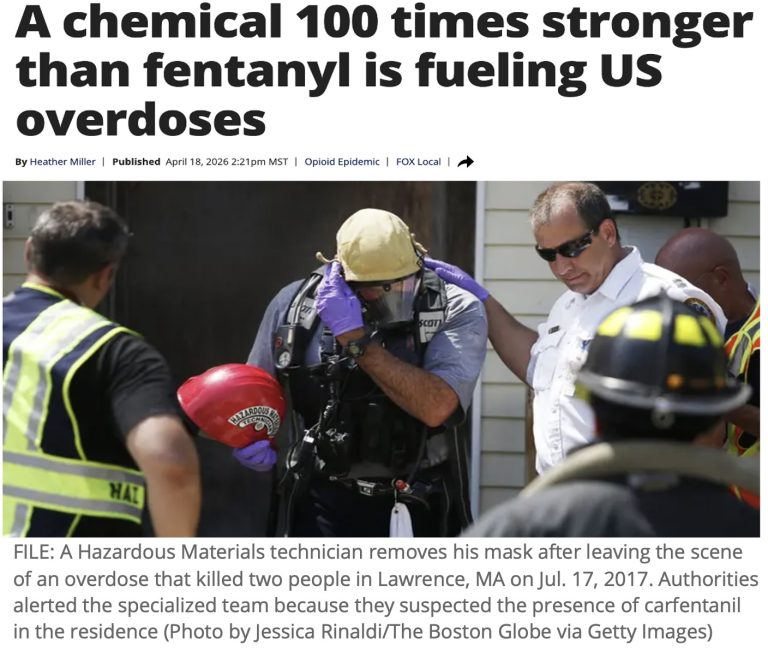
Not only could have been anywhere, but could have been cychlorphine, instead of carfentanil, or nitazenes, or the next new, potent, dangerous, naloxone-challenging synthetic to enter illicit economies of opioid use.
Because that’s how it works, has for decades. The desperate need to moderate, escape, soothe the inner pain of high-risk opioid users – pain and severe discomfort that are psychological and emotional as much or more than physical, increasingly heightened by the consequences of dependence, adding to hopelessness and loss of functioning – fuels a demand and market that can never be extinguished by drug busts, that’s established.
There’s too much to lose, too much to gain, too much at stake, for both the desperate, high-risk users and the profiteers in those economies, all parties undeterred by risk and potentially grave consequences.
The same observations and conclusions about the futility and lethality of law enforcement efforts to limit the supply of potent illicit opioids are made for the recent appearance and lethality of nitazenes and cychlopnine, two of what predictably will be continuously evolving adjustments in supply to the unextinguishable demand.
Unextinguishable, that is, by any means constructed as “treatments” provided by America’s public health and medical expert class, those “gold-standard” treatments established here as not remotely beneficial for the potentially lethal condition of compulsive substance use, an entirely non-medical condition. Instead they are fueling the crisis, lethal in their failure, medically-dispensed gold-standard opioid cure buprenorphine the common street currency for obtaining fentanyl.
We don’t have to speculate, hypothesize, or mystify the causal connections between unstable, unpredictable street illicit opioid supplies and high-risk use driving a worsening opioid crisis.
Supply disturbances are ruled out as contributing to recently reduced fatal opioid overdoses, explained here.
Instead, with uncertainty or scarcity, increased risk is driven by the indiscriminate behaviors of high-risk users desperate for any substance that will relieve their anguish, those behaviors well known, recently described here, here, and here.
Another entirely non-medical condition in the news recently is depression
incuding a report on the apparent doubling of self-reported depressed mood in adolescents and adults between 2015 and now, and this piece, linking childhood trauma to treatment-resistant depression later in life, in adulthood.
We might simply ask, as a way to generate thinking about the nature, experience, and appearance of depression, how it could be that biological phenomena associated with childhood trauma (or ACE), would not necessarily be expressed or experienced at the time of ACE occurring, or in intervening years, but “developing depression later in life that is difficult to treat”. If the neurobiological or neurochemical disturbances that are biologically active and impactful enough to be the cause of treatment-resistant depression later in adulthood are linked to adverse childhood experiences (ACE), how do we understand the absence of their being experienced or apparent over the preceding years, or decades?
We don’t, because the treatment-resistant depression emerging in adulthood is not biological, any more than any types of depression are. Depression as a biological or neurochemical condition, benefiting from medical or pharmacological treatments, has been debunked for decades, outlined in reviews, for example, here.

Under our modern, evidence-based understanding of depression, the causal links between adverse childhood events (ACE) and treatment-resistant depression are natural and cogent, they make sense.
As a young person moving through adolescence, adulthood, through life, experiences the memories, thoughts, interpretations, and painful consequences of those early experiences, that is, experiences the (non-biological) psychological and conscious representations and constructed meanings of the events, the adaptive mood state “depression” is activated by unconscious ideations of an injured, fragmented, or damaged sense of self, just as adaptive mood system elements are activated in chronic and emergent elements of PTSD with conscious or unconscious (non-biological) cognitions and psychic awareness of danger, or threat, PTSD another example of an adaptive mood system.
The nature of adaptive mood systems that have evolved in humans is such that, while they emerged over evolutionary time by promoting survival, most commonly under current conditions of living, they are misactivated, overactivated, or insensitive to deactivation when they should be deactivated or not arise. Think chronic PTSD, fueled by exaggerated fears and distorted ideation of threats and danger.
That’s where CBT comes in, as the only evidence-based treatment for PTSD, addressing the distorted, self-defeating beliefs generating a sense of vulnerability and lack of control by changing beliefs and correcting distorted, inaccurate views of self. There are no pills for that. It is not a medical condition, any more than depression is.
The same applies for evidence-based treatment for depressed mood, with a focus on distorted beliefs affecting sense of injury, wholeness, vulnerability, and impairment. That’s why regular activity has been found to be so beneficial – not due to physiological, neurochemical, or biological changes, but in experientially changing beliefs about functionality and a well, uninjured, unimpaired self. It is experiential CBT, disputing false, self-defeating beliefs of an injured, fragile, impaired self. There is no pill for that, it is not a medical condition, and adopting the lie that it is predicts harm.
All of that deserves additional attention and exploration.
For now, it’s important to consider a fundamental and very unfortunate truth. “Treatment-resistant depression” is not depression that is not responsive to treatment, because treatment has never been provided for it. Antidepressant medications, hallucinogens, and other psychoactive substances are not treatments for depression, which is not a medical or neurochemical condition. They’ve all been tried, and depression continues to mount in an untreated population. Cognitive Behavioral Therapy is effective for depression, because it treats the actual (non-biological) causes of depressed mood, but inadequately to the extent that it lacks focus on sense of an injured, fragile, vulnerable self and social loss as sense of loss of self, loss of somethng that was attached to self, “a part of me“.
Treating substance use and depression as medical conditions has worsened epidemics
That brings us to vaping,
in the news with this perspective from the Netherlands.
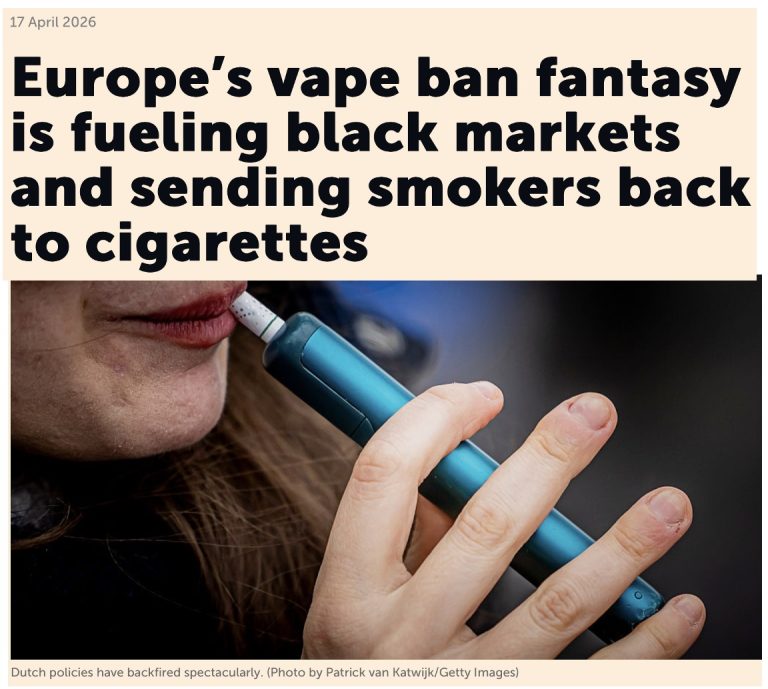
In the U.S., vaping got a strong, early boost with an endorsement as the FDA’s “innovative plan” to reduce smoking in America’s top medical journal.
Youth vaping epidemics are a worldwide phenomenon, creating dependence on nicotine at unprecedented rates and with epidemic consequences, as observed in the Netherlands.
In 2024, the Dutch government introduced a sweeping ban on all non-tobacco vape flavours.
The objective was clear: Reduce youth uptake by removing the products seen as most attractive to younger consumers.
It was a policy built on the widely cited fear of a “gateway effect”, the idea that vaping leads young people toward smoking.
But reality has not followed the script.
Instead of reducing use, the policy appears to have triggered precisely the dynamics it was meant to prevent.
Youth vaping in the Netherlands has more than doubled, rising from 3.7 per cent to 7.6 per cent in the space of a year.
The explanation is straightforward. Demand did not disappear when flavours were banned. It simply moved.
The legal market shrank sharply. Adult vaping declined, but not because consumers lost interest.
Rather, they were pushed out of regulated channels.
Today, a significant share of users report sourcing products from abroad, through illicit online sellers, or even via non-compliant domestic retailers. …
This is the first lesson of the Dutch experience: Prohibition does not eliminate demand. It displaces it — often into less transparent, less controllable, and more dangerous channels.
But there is a second, more troubling consequence. Smoking is rising again.
Cigarette consumption in the Netherlands increased in 2024, with tens of millions of additional cigarettes consumed. Even more concerning, more than a quarter of former vapers report either returning to smoking or increasing their cigarette use following the ban.
In the U.S. from media accounts, we have no idea what trends are emerging in youth vaping and tobacco use, or substance use, because those reports rely on America’s medical and public health experts using invalidated, school-based surveys that generate inaccurate pictures of those trends, distorted to claim gains against youth substance use.
The surveys excluded portions of the youth population most likely to be experiencing compulsive, problem substance use – those not regularly attending school, explained here.
And for those attending school, survey conditions, including surveillance and threats of harsh punishments, predict underreporting of substance use, explained here.
Alternative valid measures of trends in youth substance use presented in those posts (here and here) point to a worsening vaping epidemic, congruent with these more recent research analyses.


Under medical treatment models for entirely non-medical conditions, the use of psychic adaptive mood system-disturbing, medically-dispensed chemical agents, of substitute addictive chemicals, or addictive chemical delivery systems has failed no less problematically and harmfully for vaping than as for depressed mood or compulsive use of opioids.