OPIOID CRISIS LEANING INTO LIES ROUNDUP: ELEVATED KNOW-NOTHINGS; HYPER-FUNDED INSTITUTIONAL MEDIA; MAINSTAY NPR REPORTING; AND MORE
The sources and their selected experts are America’s most respected, promoted, and disseminated, their deceptions a shared lethal consensus
by Clark Miller
Published August 28, 2026
Something’s in the air, in the cloud, that looks like panic, a circle the wagons and all hands on deck distress signal, now all hands of deckhands on keyboards to spin out in concert the fabricated assertions that must be a constant refrain, in unison.
And the more desperate, massive, and intensive the emergency opioid-fatality-reversing campaigns to moderate persistent, increasing high-risk opioid use become – necessary to avoid some of that high-risk use adding to more deaths – the louder the refrain, to distract from the threat, drown out the leaking truths.
There simply is too much at stake, too much to lose from what is exposed by those revelatory rips in the matrix.
The heightened activation, though, feels imbued with impulsivity and additional levels of reckless disregard – for veracity, for reason, for evidence, and for critical thought – in ways that are self-defeating, a course we can only hope for to its end for the sake of public health and safety.
Consider this new piece published by the Brookings Institution, for example.
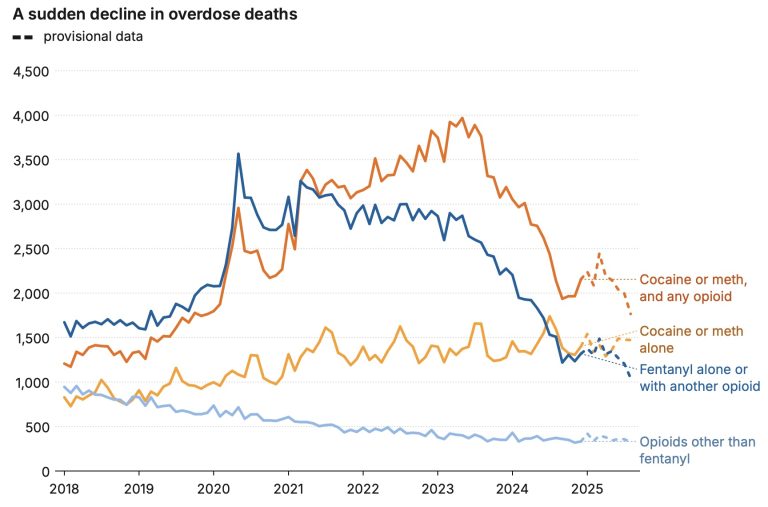
After rising for more than 40 years, the number of U.S. drug overdose deaths began to fall in mid-2023, declining from a 12-month rate of about 110,000 in June 2023 to about 72,000 in August 2025, primarily as a result of a decline in the number of deaths involving fentanyl. …
This plateau was six times the figure for 2000 and represented a continuation of a 40-year increase. The sudden and substantial downturn that followed was unforeseen and broad-based: It accelerated the declines in states that were hit first by fentanyl and were already past their peaks and flipped the trajectory of states where deaths had still been rising.
[emphasis added]
Actually? It’s quite clear that deaths had been on a downward trend prior to mid-2023, beginning around 2020 and then surging back up over a period when lockdowns, breakups of social groups of high-risk users, and other disruptions would have diminished the fatality-protecting effects of naloxone campaigns ramping up at that time.
“unforseen“? Only by lack of familiarity with the evidence, including, for example, the dramatic downturn in opioid-related deaths in this Ohio county attributed directly to an early, effective naloxone campaign. When? In 2018.
One of the more egregious and telling fictions –
Furthermore, while the decline was not exactly the same size in all states, it was broad and better thought of as a nationwide, not merely a regional, phenomenon.
In fact, a striking feature of the course of trends in opioid-related overdose deaths has been how remarkably disparate they have been across regions, states, and locales, for example, between two adjacent parishes in Louisiana (and here).
Just how variable the trends have been is highlighted in this analysis by The Guardian and by the graphics in that piece. Take a look at that post – the differences are consistently, invariably accounted for by clear, evidenced variations in scale, effectiveness, and timing of naloxone campaigns, or lack thereof, the many apparent exceptions to broader trends proving the lethal rule – that those campaigns entirely account for reductions in opioid overdose deaths.
More egregious yet are the claims –
Naloxone could have had a major effect on fatal overdoses if used more regularly, but an early study found that only about 9% of pharmacies chose to stock it. Data from the National Emergency Medical Services Information System provided to us by Andrew Thompson offer useful context for evaluating naloxone’s role. The total number of naloxone-related emergency medical service (EMS) activations fell substantially over this period, from roughly 32,000-37,000 per month in 2022 to approximately 23,000-26,000 per month by 2025, a decline of around 25% to 30%.Notably, the share of activations in which naloxone had been administered before EMS arrival rose only modestly, from about 16% in early 2022 to about 20% by early 2025. Much of that shift appears to reflect improved documentation rather than a meaningful increase in bystander naloxone use because the share of cases in which naloxone was definitively not administered before EMS arrival remained essentially flat throughout the period. Taken together, these patterns suggest that the decline in EMS overdose activations reflects fewer overdose events occurring overall, rather than a growing share being intercepted upstream by bystanders with naloxone. Further circumstantial evidence comes from Canada, which made the overdose reversal drug available seven years earlier in 2016 yet experienced a parallel decline in opioid overdose deaths at generally the same time. Though increased access to naloxone may well have saved lives, it is not clear that it made a large contribution to the observed decline.
What is known, established by reports consistently from locales across the U.S. is that –
– Intensive, targeted campaigns to train on and distribute naloxone targeting high-needs areas are unrelated to pharmacy dispensing, instead implemented by a variety of community-based and public health organizations.
– Predictably, EMS calls and responses have dwindled as reversals have shifted to laypersons and peers
– Consequently, estimates of nonfatal overdoses are considered to be gross underestimates.
– In locales from which data are available, the magnitude of increases over time in numbers of reversals more than accounts for, often many times more, drops in fatal overdoses for the time period.
In California, for example, where community-based groups distributing state-provided units are required to provide estimates of reversals, those far more than account – after adjustments to err on the side of avoiding overestimates – for dramatic drops in fatal overdoses.
The Brookings report authors are led to conclude that while naloxone campaigns cannot account for the drops in deaths, very likely those decreases can be accounted for by changes in “characteristics of the drug supply”, behaviors of high-risk users, and reduced numbers of high-risk users due to mortality without comparable increases in new users.
Those explanations, however, are ruled out, invalidated,
in fact all explanations apart from naloxone campaigns are ruled out on the basis of widespread evidence available.
That is because, in distinct contrast to naloxone, which prevents a fatality after high-risk use has led to an overdose with risk of fatality, all other interventions and explanations CAN ONLY REDUCE FATAL OVERDOSE by reducing high-risk use. And the evidence consistently points to high-risk opioid use persisting or increasing everywhere.
That, of course, was predictable from the established lethal failure of expert gold-standard treatments.
But it’s not just a couple, or a handful, or even a majority of experts leaning into the lies that hide a worsening opioid crisis fueled by treatment failure.
It’s a consensus of mystification and fabrication.
From Think Global Health, of the Council on Foreign Relations and Washington University, funded by Bloomberg Philanthropies, a piece assailing readers with oversized images meant to employ a mother’s grief to support lethally failed gold-standard treatments.
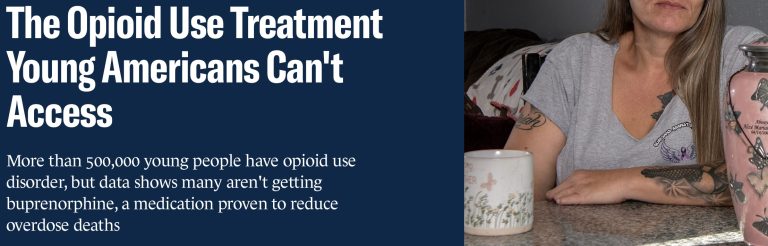
Approved medications for opioid addiction exist. One effective option, known as an agonist, activates the same brain receptors that heroin and morphine do. That function helps prevent cravings and withdrawal symptoms, affording those prescribed a better chance to stop misusing opioids, said Brendan Saloner, a professor of addiction medicine at Brown University. It also lowers their risk of overdose, he added—by as much as half, some data indicates. “We have ample research going back decades that shows that, when patients have this disorder, when they’re on medicine, they tend to do better,” Saloner said.
That sounds so reassuring. The problem is that, as reinforced by the largest-ever $344 million NIH study reinforcing its lethal failure, there has never been compelling evidence for any benefit (and here) from medical use of the substitute opioid buprenorphine, instead overwhelmingly for harm.
Barrier Upon Barrier to Access
Buprenorphine has always been underprescribed, Saloner explained, especially for young people. But data suggests that the number of prescriptions for people younger than 26 has shrunk in the last decade but increased for anyone older than 34. Fewer than 39,000 patients ranging from mid-teens to early adulthood filled buprenorphine prescriptions in 2023—roughly 3,000 fewer than in 2017. Over the same period, fatal overdoses among young people grew by a quarter, peaking during the COVID-19 pandemic, accounting for 1 in 18 of the country’s opioid deaths that year.
That’s all completely irrelevant, it turns out, because any young adult getting illicit opioids on the street also has access to one of the most common, affordable, and safest – buprenorphine, functioning for decades as an integral commodity and currency in those illicit economies of opioid use. That’s covered here and elsewhere at ACD, in a recent post –
Far from being difficult to access, buprenorphine has been known and established as one of the most widely and easily obtainable diverted drugs in street and community economies of illicit opioid and other drug use, functioning as a consumable, commodity, and currency. That’s described in multiple posts here at ACD, for example here and here and here.
“Those seeking treatment often face delays”? What “treatment”? The alleged, “evidence-based” benefit that “saves lives” comes entirely from ingesting the pills or sublingual strip, providing the rationale for prescribing by telehealth and “low-barrier” access. If “bupe” works, it works by simply using it daily, is no more complicated than that.
The fastest, lowest-barrier, most reliably available access to “subs” – cheap and safe – is getting it from the same sources other illicit drugs are obtained from in a high-risk user’s neighborhood, available 24/7 in any community. The scarcity rationale for the established lethal failure of buprenorphine is a demonstrable lie. If your cousin could get the diabetes medication he needs to stay alive and well easily, safely, cheaply, 24/7, in his community, as he could buprenorphine if he needed it, from the same guy he scores his ketamine from, we would be, like the thought leaders useful idiots at R Street, lying to say that accessing his life-saving medication is “challenging”.
Saves lives? It turns out that there has never been a body of evidence to support that fabrication, studies consistently confounded by the predictable association of provision, training, and proximity to possession, use, and reversal of potentially fatal overdoses by naloxone for anyone accessing buprenorphine from medical or treatment program involvement and visiting pharmacies to get it. To claim it was the buprenorphine requires ruling out that it was the associated provision and proximity to life-saving naloxone instead.
Instead, evidence consistently establishes buprenorphine (and methadone) as fueling the lethal crisis. The more those substitute opioids are provided, the more lethal the outcomes and course of the crisis, as we saw for Baltimore.
Back to our current post,
and more exploitation of unfortunate victims of American healthcare in the service of hiding the lethal failure of expert opioid cures.
Addiction treatments are safe, effective — and rarely offered
According to Meyerson, the problem isn’t just in hospital emergency rooms. It’s still the norm for doctors and nurses across U.S. healthcare settings to avoid treating patients with alcohol- and drug-related disorders.
“If I’m at my own general practitioner and it’s suddenly clear I’m addicted to an opioid, my doctor will likely send me somewhere else,” Meyerson said. “Versus [saying], I can treat that here, just like I can treat your diabetes or any other chronic disease you might have.”
This happens despite the fact that safe and affordable medications for treating the deadliest forms of addiction have been available to U.S. clinicians for decades. “We have good tools. Methadone and buprenorphine are gold standards,” Meyerson said. “Access to treatment would reduce opioid overdose by 60%. In some studies, I saw 80%.”
In 2022, Congress lowered regulatory barriers, making it far easier for nonspecialist clinicians to prescribe buprenorphine, a medication that reduces opioid cravings. But most doctors still don’t. It’s even rarer for doctors to offer naltrexone, a medication that helps patients by reducing the desire for alcohol.
[emphasis added]
Of course it is, a chronic disease, a medical condition to be successfully treated by doctors.
The expert treatments are gold-standard treatments.
That goes without saying.
In case all of that, from America’s esteemed institutions and top media citing respected experts, were not enough, there are the assurances of others, as knowledgeable and authoritative as a recovery advocate, for example, featured here in The Hill.
Just as we are gaining ground, Washington is tearing up the foundation beneath us. The 2025 reconciliation law cuts more than $900 billion from Medicaid, the largest payer for mental health and addiction treatment in the country. An estimated 10 million people will lose coverage. …
We cannot keep patching a broken system. We need to rebuild it, the way the original New Deal built highways and electrified rural America. A New Deal for mental health and addiction starts with the workforce: pay therapists, counselors and peer specialists a living wage, speed up licensure and enforce the parity laws that require insurers to cover this care like any other. …
It also means embracing technology. Telehealth knocked down the two biggest barriers to care almost overnight: distance and weeks-long waits. After sustained pressure from the National Alliance on Mental Illness and the recovery community, federal regulators finalized rules allowing providers to start treatment for opioid use disorder by video, including prescribing medications like Suboxone.
Bicycle Health, which calls itself the country’s largest telehealth provider focused on opioid use disorder, has treated more than 50,000 patients. None of this happens without voters demanding it.
[emphasis added]
With that level of energetic cheerleading for all the right things, what could go wrong?
Medicaid and its expansion to treat high-risk opioid use? Just look at the outcomes!
Peer specialists! And the value of their training and competence. More funding for that!
And who could argue with the value of telehealth and the loosening up of dispensing of “bupe”?

And how blessed are we, to have an organization like Bicycle Health provide telehealth treatment to 50,000 opioid users!
That has had to make a difference, right? I mean, it would have to. Right? 50,000?
It must be that high-risk opioid use is decreasing? It must be, right?