ANOTHER CITY, SAME STORY: IN NEW ORLEANS, NALOXONE REVERSALS HIDE A WORSENING OPIOID CRISIS DRIVEN BY LETHAL FAILURE OF EXPERT TREATMENTS
As elsewhere, the time courses of opioid death reductions and community saturation with naloxone are synchronous and linked by causality without evidence for alternative explanations
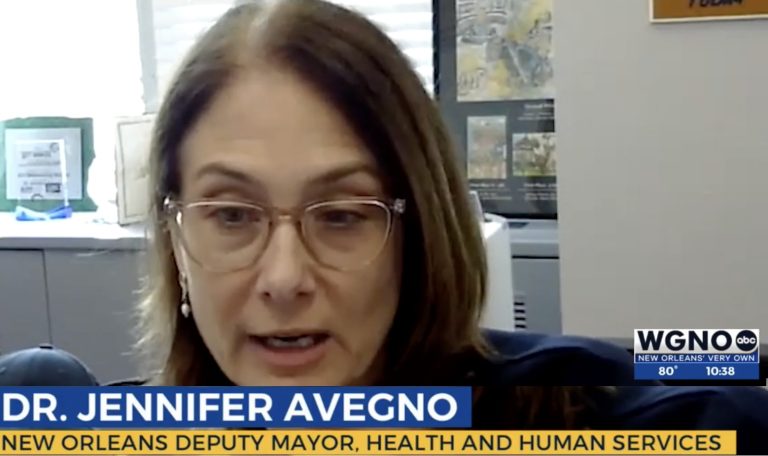
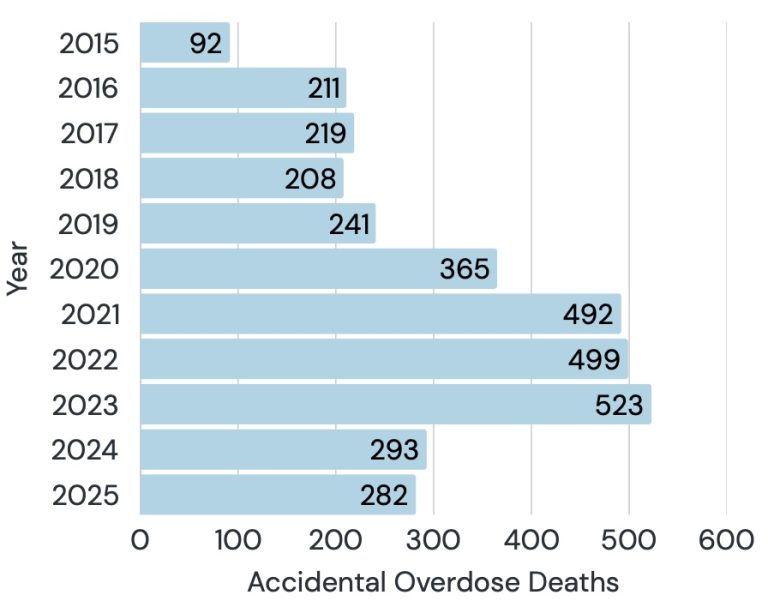
In a local news report, a New Orleans Department of Health official attributed that drop, accurately, to “Narcan distribution and bystander readiness training”, without compelled expressions to validate the pretense that any other forms of “treatment” or prevention played significant roles. As in Baton Rouge Parish, it has been clear that intensive, targeted, effective efforts to get naloxone into the trained hands of proximate laypersons, with thousands of reversals reported (and many more unreported), have been more than enough to account for the remarkable 44 percent decrease in overdose deaths in 2024, compared to 2023.
It’s important to note that the graphic is for drug overdose deaths, not only opioids. Fatalities testing postive for fentanyl comprised 69 percent of the total in 2025 and 71 percent in 2024.
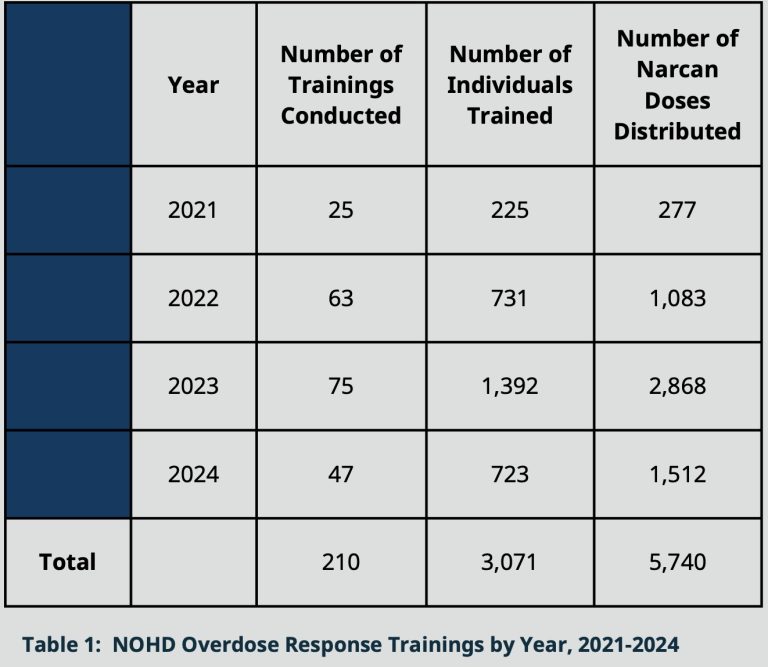
The large drop in 2024 is explained – entirely – by the magnitude of naloxone distribution and training efforts that increased dramatically in 2022 and especially 2023, priming communities and neighborhoods for the most effective naloxone responses, by a person proximate to the overdoser, when seconds count.
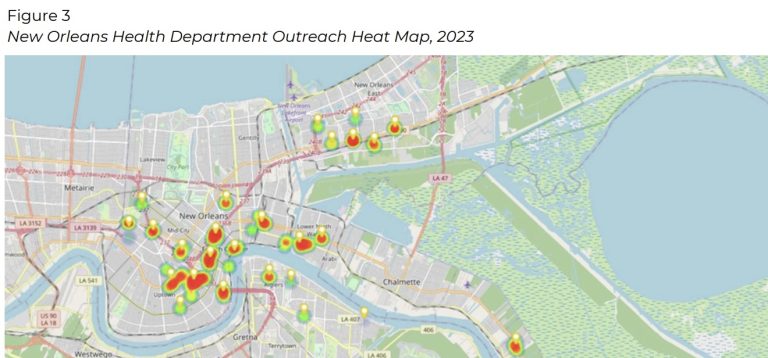
Equally dramatic and with likely more impact on Narcan reversals of potentially fatal opioid overdoses and the dramatic drop in deaths in 2024, beginning 2022 and into 2023, NOHD intensified the quality and effectiveness of its naloxone campaign by use of targeting of high-risk areas and street-level outreach, also in training and supplying community partners with Narcan to distribute.
In 2022, local agencies participating in NOHD’s Community Health Improvement Plan (CHIP) identified a need to expand harm reduction and overdose response trainings. In an effort to do so, CHIP members established a train-the-trainer program in the summer of 2023 for any individuals interested in facilitating overdose response trainings of their own. These trainings are typically provided to agencies who plan on distributing Narcan to their client base, with the goal of providing foundational knowledge developed by experts in harm reduction. …
In addition to overdose response trainings, NOHD distributes Narcan throughout the community via regular outreach, using overdose data provided by New Orleans Emergency Medical Services (NOEMS) and the Overdose Detection Mapping Application Program (ODMAP) to help inform outreach locations.
These outreach events provide community members with a quick, on-the-street introduction to overdose response including how to identify an overdose and administer NOHD-provided naloxone. NOHD kits include two doses of nasal-spray Narcan, instructions on how to use it, a community resource guide outlining where people with substance use disorder can access treatment, and a phone number for individuals to call should they want or need more Narcan.
[emphasis added]
There is another highly significant factor to consider that was predictable from the intensive, community-based, targeted and successful naloxone campaign that surged through 2022 and 2023 and prepared and supplied laypersons for remarkable increases in opioid overdose reversals.
It is the established (here, for example) consistent effect of effective, layperson-targeted naloxone campaigns in shifting overdose reversals away from emergency responders and to those provided by family members, passers-by, other high-risk opioid users, and other proximate associates. Because of generalized disincentives for formally or otherwise reporting such overdoses (= instances of high-risk opioid use = expert treatment failure), prevalence of reversals = instances of high-risk opioid use = expert treatment failure) is increasingly underestimated.
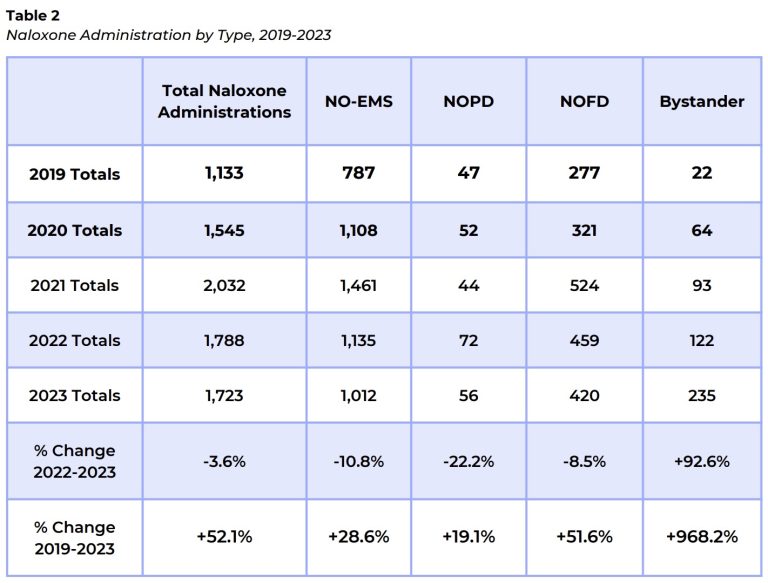
That trend and effect are clear from Table 2 of the 2023 NOHD report.
NO-EMS, NOPD, and NOFD are first responders.
But what can explain the much smaller decrease in opioid overdose deaths, 4 percent, in 2025, compared to the 44 percent from 2023 to 2024?
The explanation is predictable and establishes New Orleans as another “exception” that’s not an exception, instead proving the lethal rule consistently validated: that it has been solely naloxone campaigns and not any other factors reducing opioid-related deaths, not “treatment“, not medical cures, not other distracting fabrications, those sham cures instead driving the worsening epidemic.
In 2024, the Behavioral Health Team experienced some staffing changes, including the hiring of an Opioids Special Projects Coordinator. Additionally, thanks to Opioid Settlement Funds, the New Orleans Health Department (NOHD) filled the Opioid Outreach and Education Coordinator position, which had been funded by a federal grant that ended in March 2024. While NOHD’s already-established prevention activities–including Narcan distribution–continued, these changes in staffing and funding sources resulted in some stalling of program activities, as is evident by fewer Narcan trainings and distribution during outreach events in 2024 (Table 1). The Outreach and Education Coordinator hit the ground running in the fall of 2024 and the Behavioral Health team is confident 2025 will see our Narcan distribution efforts in line with previous years.
[emphasis added]
It was the Narcan.
Whereas effective, coordinated, funded efforts through 2022 and 2023 provisioned, resupplied, and prepared community members in community high-risk hot spots to respond effectively to potentially fatal opioid ODs running up to 2024, that failed in 2024 with loss of funding early in the year and key staff not back on board until “fall” of 2024.
Let’s wrap this up,
by taking a look at a couple of entirely congruent, replicating, additionally validating bodies of evidence.
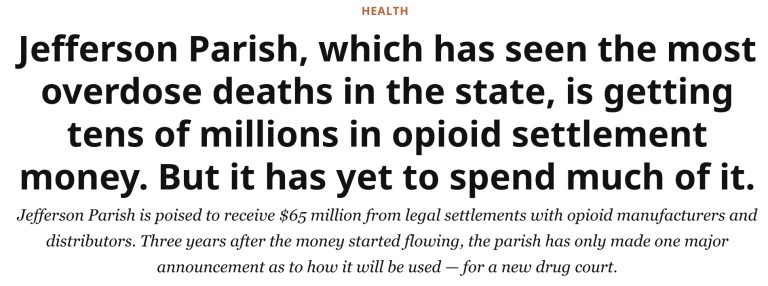
Jefferson Parish, neighboring New Orleans, provides a stark contrast.
The conservative-leaning, suburban parish — where many move to for lower property taxes and quieter neighborhoods than in neighboring New Orleans — has the highest rate of opioid-related overdoses in Louisiana, more than any other parish in the state according to data published by the Louisiana Department of Health. …
Before advising Jefferson Parish, Babcock worked for the city of New Orleans from 2013 until 2021. In 2017, as New Orleans was facing a dramatic uptick in opioid-related deaths, the city’s health department worked to distribute naloxone across city services, using geographic data provided by the city’s Emergency Medical Services to map where overdose calls were occurring. The Health Department used that data to then figure out where to distribute naloxone.
This was part of a strategy called harm reduction, an evidence-based public health approach that seeks to offer resources that minimize the risks associated with drug use — like offering fentanyl test strips, clean syringes and naloxone to those who use drugs — and is shown to be an effective public health approach, increasing the likelihood that people who use drugs will enter treatment, lowering mortality rates and the spread of disease.
“So, personally, what I’ve seen as I’ve worked in both parishes is that Orleans Parish took a much more proactive response stance early on in this epidemic, and Jefferson Parish has, in many ways, moved slower to address it,” Babcock said.
That’s putting it graciously, isn’t it?
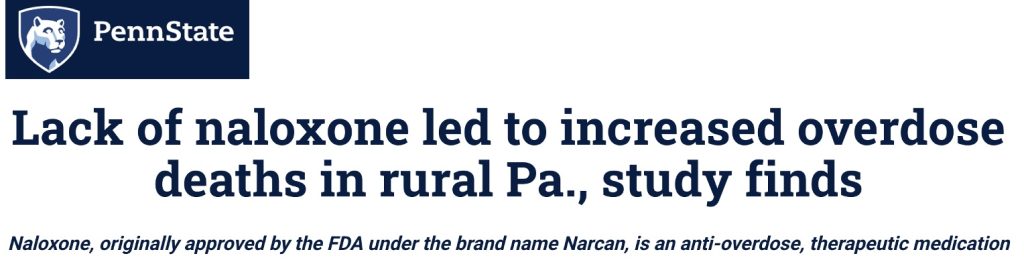
Research in Pennsylvaniafound that, comparing counties, opioid overdose death incidence was explained by differences in capacity for Narcan response.
Because an uncontrolled epidemic of desperate and deadly use of pain-numbing opioid drugs is just the most visible of America’s lethal crises of drug misuse, suicide, depression, of obesity and sickness, of social illness. Because the matrix of health experts and institutions constructed and identified by mass media as trusted authorities – publicly funded and entrusted to protect public health – instead collude to fabricate false assurances like those that created an opioid crisis, while promising medical cures that never come and can never come, while epidemics worsen. Because the “journalists” responsible for protecting public well-being have failed to fight for truth, traded that duty away for their careers, their abdication and cowardice rewarded daily in corporate news offices, attempts to expose that failure and their fabrications punished.
Open, critical examination, exposure, and deconstruction of their lethal matrix of fabrications is a matter of survival, is cure for mass illness and crisis, demands of us a critical discourse.
Crisis is a necessary condition for a questioning of doxa, but is not in itself a sufficient condition for the production of a critical discourse.