ROUNDUP: MORE MEDICAL “TREATMENT” FAILURE FOR NON-MEDICAL CONDITIONS; NIH WASTES ANOTHER $3.9 MILLION; UNSUSTAINABLE COSTS OF SERIAL NARCAN REVERSALS
The mounting toll of public health harm and waste is incalculable
by Clark Miller
Published May 29, 2026
This was predictable.
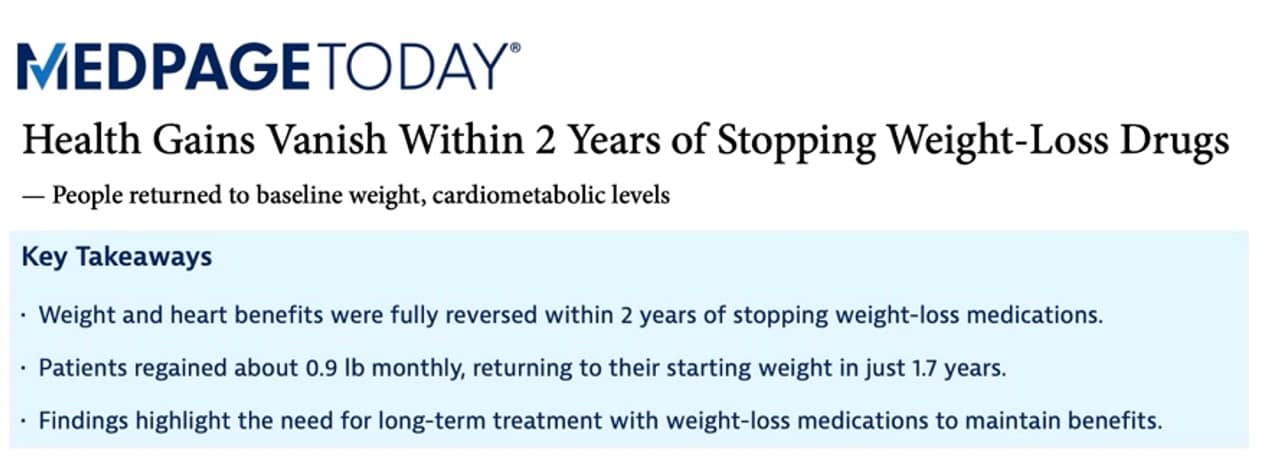
Regardless of initial weight loss, people regained weight faster, by 0.7 lb per month, after stopping weight management medications compared with behavioral weight management programs.
“As obesity is a chronic and relapsing condition, prolonged treatment with WMM [weight management medication] may be required to sustain the health benefits,” West and co-authors noted. “This evidence cautions against short term use of WMMs, emphasizes the need for further research into cost effective strategies for long term weight control, and reinforces the importance of primary prevention.”
The results didn’t come as much of a surprise to Qi Sun, MD, ScD, of Brigham and Women’s Hospital and Harvard Medical School in Boston. It’s “well documented that reduced adherence to, or cessation of, dietary and lifestyle interventions leads to similar patterns of weight regain,” he wrote in an accompanying editorial.…
This investigation was timely as the popularity of weight management medications like GLP-1 receptor agonists continue to skyrocket, Sun observed. That said, real-world data have shown that roughly half of peopleopens in a new tab or window who start a GLP-1 drug ditch it within the year.
The findings cast doubt on the idea that GLP-1 drugs “are a perfect cure for obesity,” Sun pointed out. “Issues such as high costs, side effects, and the inconvenience of injections are among some common reasons for discontinuing the medications,” he wrote.
Healthy diet and lifestyle, public health measures like sugary beverage taxes, and bariatric surgery for certain patients may be ways to manage weight regain after drug cessation, Sun suggested.
[emphasis added]
The idea that an injected (or oral) appetite-suppressing drug would address the entirely non-medical condition of compulsive use of food to psychologically numb or soothe underlying psychic and emotional distress (the cause of overweight and obesity in children and adults) is as lethally and pathologically derelict as that approach for problem opioid use and any other substance use condition.
If simply sticking to a “Healthy diet and lifestyle” program were effective, without the psychotherapy required to address those underlying forces driving the compulsive use, the unfolding GLP-1 public health assault would have been a harder sell.
The sinister part sounds very familiar, from a few decades ago when the substitute opioids buprenorphine and methadone were envisioned (and pitched) as transitional, to be weaned off of after helping to get off heroin (then).
“As obesity is a chronic and relapsing condition, prolonged treatment with WMM [weight management medication] may be required to sustain the health benefits,” West and co-authors noted.
Get that? It’s the same lie, as for chronic pain, for depression, and all substance use problems – You are helpless against this chronic and relapsing medical condition, and must expect to be on our medications for the rest of your life.
And these claims predictable, for the next medical game-changer
as likely to provide benefit as the exciting, heralded game-changers that have come before: buprenorphine and its fail-safe injectable formulation, Sublocade.
This exciting “non-opioid pain treatment” happens to be a medication, so there is a significant problem. The problem is that no medication or drug does or can treat the entirely non-medical, psychogenic condition of common chronic pain, experienced by 25 million Americans. So, that’s $3.9 million in public healthcare funds wasted by the National Institutes of Health.
That sounded so negative, didn’t it?
Let’s be more generous. That $3.9 million is a fraction of the $344 million NIH spent on the largest-ever research project to validate the use of “addiction medicine” against the opioid crisis – to validate the “medication assisted treatment” (MAT, MOUD) that has by consensus been assured by experts and media as already established for decades as the “proven“, gold-standard treatment for compulsive opioid use.
Travis County in Texas, like most locales and states in the U.S., has achieved dramatic reductions in opioid overdose deaths over recent years due to intensive, effective naloxone campaigns.
And that included a heartfelt description of the reversal of an otherwise fatal opioid overdose by a direct service social services worker there.
Recounting the reversal on camera, the woman who saved a life expressed, with emotion, powerful sentiments from the experience, “this man has a family … this man now has a chance to go home to his family”.
Every naloxone reversal is justified, ethically compelled, and not without hope for change.
And, as has evolved as a routine, repeated, serial practice and the only force moderating a worsening crisis in the absence of effective treatments, has severe costs.
Other hidden costs are broader and generational, when the family members – adults and children of a revived and returning overdoser – are at risk of ACE and traumatization by the conflict, dysfunction, and potential trauma of drug use and overdose or death that will predictably set them up to be, in turn, more vulnerable to problem substance use.
Because an uncontrolled epidemic of desperate and deadly use of pain-numbing opioid drugs is just the most visible of America’s lethal crises of drug misuse, suicide, depression, of obesity and sickness, of social illness. Because the matrix of health experts and institutions constructed and identified by mass media as trusted authorities – publicly funded and entrusted to protect public health – instead collude to fabricate false assurances like those that created an opioid crisis, while promising medical cures that never come and can never come, while epidemics worsen. Because the “journalists” responsible for protecting public well-being have failed to fight for truth, traded that duty away for their careers, their abdication and cowardice rewarded daily in corporate news offices, attempts to expose that failure and their fabrications punished.
Open, critical examination, exposure, and deconstruction of their lethal matrix of fabrications is a matter of survival, is cure for mass illness and crisis, demands of us a critical discourse.
Crisis is a necessary condition for a questioning of doxa, but is not in itself a sufficient condition for the production of a critical discourse.