NATIONAL YOUTH HEALTH SURVEY INVALIDATED RESULTS ARE BECOMING EVEN LESS VALID
Results are increasingly invalid as response rates drop differentially, with uncontrolled selection bias, while youth health epidemics worsen
by Clark Miller
Published November 27, 2026
It’s important to understand, from the outset, something about the large, national school-based surveys that experts and media use to assure you of declines in youth substance use and gains in well-being.
Reality check – these are NOT “youth” surveys, and results don’t represent “youth”, because American youth are not surveyed, instead a very select subpopulation of American youth, a subset known to distort their repsonses to substance use questions. We’ll get to all of that.
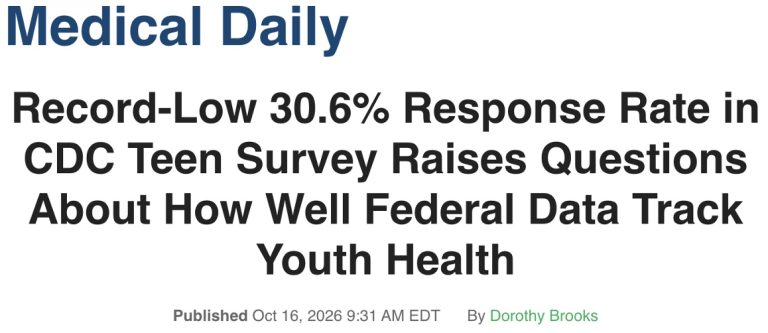
But first, a recent medical news piece highlighted one aspect of what should be invalidating concerns about the surveys.
The federal survey that parents, schools, and health departments rely on to track teen health had the lowest participation in its more than 35-year history. The 2025 Youth Risk Behavior Survey (YRBS) had an overall response rate of 30.6%, according to a CDC methods report on the survey dated Oct. 15 in the Morbidity and Mortality Weekly Report.
The main driver was schools. Of 230 schools selected for the national sample, 108 agreed to participate, a school response rate of 47.0%. Among students in those schools, 65.2% completed the survey, a figure the CDC said remained comparable to previous cycles.
The concern is practical. YRBS numbers shape how communities respond to teen depression, vaping, nutrition, and safety. When fewer schools participate, there is more uncertainty about whether the results reflect every teen.
[emphasis added]
Yes, “more uncertainty,” possibly because diminishing response rates, with undescribed driving factors and potential for bias, magnify selection biases.
But certainty about our main concern: that the outcomes of the national surveys, increasingly, are invalidated by multiple problems, including selection bias and other distortions. We’ve covered that here –
Let’s go back to that new report in Medical Daily. That fewer than half of schools selected agreed to participate, the decliners skewed toward private schools and “schools below the median poverty level”, is itself invalidating of results, particularly because how that selection bias affects results is not clear and not known by us, nor by the CDC or the media/public health consensus spinning results as reflecting gains for youth health.
That gap matters for accountability. Without knowing why schools say no, it is hard to judge whether the fixes the CDC has planned will work.
And more importantly, impossible to conclude with confidence that outcomes from the diminishing population sampled reflect real levels and trends among youth, i.e., are externally valid.
But apart from schools abstaining and unaddressed in the Medical Daily report, there are more serious, known distortions that have been invalidating results.
As noted in the report, in passing, there is no sampling of youth from the targeted age group who are not in school –
The survey also excludes homeschooled teens and youths not enrolled in school, who made up about 5% of 14- to 17-year-olds in 2022 and may face different health risks.
“may face different health risks”
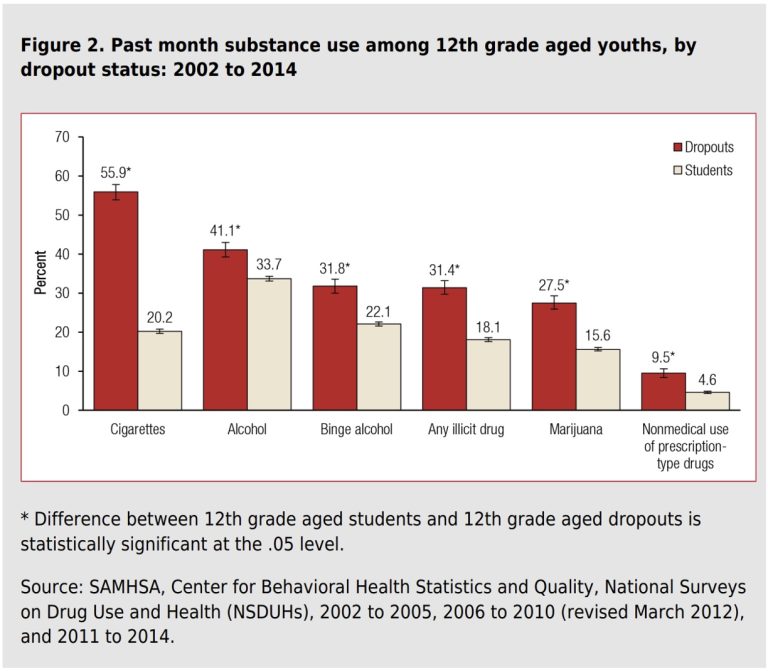
Like the health risk of significantly higher prevalence of substance use, from this SAMHSA report, for “12th grade aged youth by dropout status” –
Considering this question more broadly for age group and for more recent years, it has become clear that the large subpopulation of kids affected by being in an opioid-abusing family are affected with higher prevalence of chronic school absenteeism, dropout, and higher prevalence of problem substance use, among other problems.
We can predict with confidence that the combined effects of dropout, absenteeism, and family stress and dysfunction would contribute to those substance-abusing youth being under-sampled on the national, school-based surveys.
We can also confidently predict that the parent consent required to have a child participate in a survey of this type is differentially withheld in these types of challenged family settings.
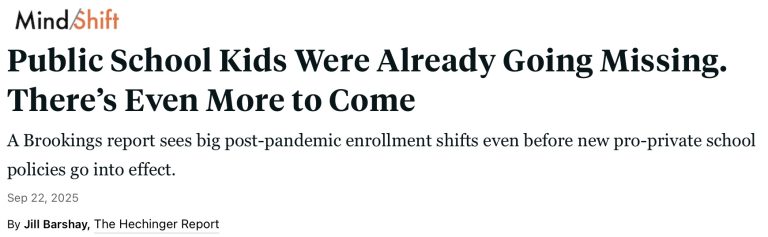
But that’s only about the millions of school-aged kids missing from schools, not enrolled, as described, for example, in the Brookings report linked to below, and estimated in the Medical Daily report as 5 percent of the teenage population.
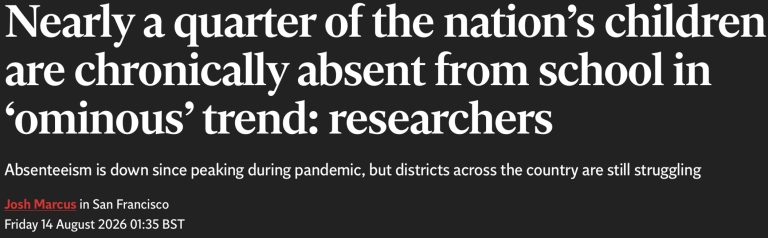
5 % of youth missing from school, 23 % enrolled and chronically absent
The associations of chronic absenteeism with youth substance use, health, and other problems are outlined here. Clearly, defending the validity of the national surveys in question would require evidence demonstrating that the 23 percent of youth who are chronically absent from the site where surveys are provided are not under-sampled.
It may be more than coincidental that states at the top for chronic school absenteeism – Alaska, Oregon and New Mexico – have also been at the top for severity of outcomes in the opioid crisis.
A picture has emerged of incontrovertibly biased national youth health surveys with lack of external validity (lack of expectation that results actually described American youth), with significant underestimation of problem substance use by American youth.
Additional defects in design, implementation futher invalidate results
Parent permission is required for a student to be administered the surveys. Let’s think about that.
We’ve seen that it is established, some of the evidence outlined here and here, that for kids from families affected by opioid abuse and associated stressors along with kids chronically not showing up at school, there are strong associations among school absence, mental health problems, and problem substance use.
We could have predicted that, and predict as well that for parents of those children, there is higher prevalence of dysfunction and stressors generally, including mental health conditions, ineffective parental functioning, impairment by substance use, and diminished engagement in parenting.
For differential probability of parental consent, itself, to NOT be considered to invalidate survey results would require evidence that the evidence and factors outlined above DO NOT act to significantly underrepresent in surveys the youth in those households and known to engage in problem substance use at higher prevalences.
The known effects of respondents intentionally underrepresenting their substance use on self-report surveys were completely ignored in the Medical Daily.
Here’s an example of the relevant research discussed in this related post –
What do we know about surveys relying on self-report
for substance use, and for substance use by youth?
A 1994 “review and meta-analysis” study of validity of self-report of smoking (cigarettes) including by youth (students) concluded that degree of validity as evaluated by biomarker confirmation
“proved quite variable among studies, as shown in Table 1, suggesting that specific aspects of the setting, study population, measurement methods, and study purpose are important to the accuracy of smoking self-reports”.
and that
“results suggest that interviewer-administered questionnaires yielded higher estimates of sensitivity and specificity than did self-administered questionnaires”.
and
“Even in the most conservative analyses, student self-reports had lower sensitivity than studies using reports from subjects in the general population; however, the results were not always statistically significant. That is, students appear more likely to deny smoking, even when biochemical measures classify them as smokers. This is not surprising, since smoking by minors is illegal in most states and many young tobacco users have not yet defined themselves as smokers. Both of these conditions would contribute to a tendency, whether conscious (fear of being found out) or unconscious (self-definition inconsistent with behavior), to underreport.”
In a study published February 2025, biological verification of tobacco smoking for Chinese adolescents providing school-based self-reports on surveys showed underestimate of self-report “current smoking” by 30 percent.
Another recent study, published February 2025, looked at self-reports by U.S. teens of nicotine use by vaping and smoking, compared to biomarker validation, and before and after legal smoking age rose from 18 to 21.
As reported in Medical Xpress,
Based on survey data, young adults covered by Tobacco 21 (T21) laws say they are smoking less. Biomarkers paint a smokier picture. Despite recent reports of tobacco bans’ success, new research shows 18- to 20-year-olds are finding ways to get cigarettes and vapes. Traces of nicotine and tobacco in their bodies prove it.
First-of-its-kind research developed by Wake Forest University economist Erik Nesson and published in the peer-reviewed Journal of Health Economics shows that since the enactment of state T21 laws between 2016 and 2019, young adults aged 18–20 are more likely to report that they don’t smoke—although a study of biomarkers for their tobacco and nicotine exposure tells a different story. ..
What makes this new study unique?
PATH data include self-reported answers to survey questions in addition to the results of medical tests that detect biomarkers for tobacco and nicotine exposure.
Nesson’s study, “The effects of tobacco 21 laws on smoking and vaping: Evidence from panel data and biomarkers,” is the first to analyze both the PATH survey data and the biomarker results, which makes all the difference.
“When you measure tobacco use using only self-reported survey data, you find T21 policies are effective at reducing tobacco use, especially cigarette smoking,” said Nesson. “But when you measure the same young adults’ recent exposure to tobacco through biomarkers in their urine, you don’t see any changes in recent exposure. Policymakers need to be aware of the unintended consequences of the policies they put in place. Sometimes they can be positive, but sometimes they can be negative.”
[Emphasis added]
Let’s keep in mind a critically important point.
None of the studies just cited and consistently pointing to significantly under-measured, invalid results for self-report of substance use, specifically nicotine, were based on survey settings or conditions that rise to the level of predicted inhibition of provision of accurate responses as the two national surveys in question, that we are evaluating.
If that’s not apparent, please return to the top of this post and review the linked news pieces describing the levels of use of surveillance, detection, threat, and consequences facing students who were recently surveyed.
Whatever degrees of distortion and diminished validity are indicated by the biomarker studies cited, new conditions for the recent national surveys compel us to assume that predicted validity for those results is lower yet.
Back to our current post.
Those “new conditions for the recent national surveys”?
They are described in detail in the post we just excerpted.
If your interest has held you to read this far, there’s a good chance you would find other material in that lengthy post valuable, including (near the end) examples of alternative, valid sources of evidence that paint a very different and more concerning picture of the well-being of America’s youth than the fictions of trusted experts and media.
Sources of externally valid, relevant, and credible findings and analysis as here
Because an uncontrolled epidemic of desperate and deadly use of pain-numbing opioid drugs is just the most visible of America’s lethal crises of drug misuse, suicide, depression, of obesity and sickness, of social illness. Because the matrix of health experts and institutions constructed and identified by mass media as trusted authorities – publicly funded and entrusted to protect public health – instead collude to fabricate false assurances like those that created an opioid crisis, while promising medical cures that never come and can never come, while epidemics worsen. Because the “journalists” responsible for protecting public well-being have failed to fight for truth, traded that duty away for their careers, their abdication and cowardice rewarded daily in corporate news offices, attempts to expose that failure and their fabrications punished.
Open, critical examination, exposure, and deconstruction of their lethal matrix of fabrications is a matter of survival, is cure for mass illness and crisis, demands of us a critical discourse.
Crisis is a necessary condition for a questioning of doxa, but is not in itself a sufficient condition for the production of a critical discourse.