WORSENING OPIOID CRISIS ROUNDUP: THE SIGNS ARE EVERYWHERE
Local reporting is more reliably accurate, sources often direct service workers observing what is real, with little to lose from exposure of expert treatment lethal failure
by Clark Miller
Published November 20, 2026
By far, the most common focus of posts here at ACD has been on broad trends in public health policy and practices driving health outcomes and other measures, along with the cultural and institutional forces driving those trends and outcomes. That necessarily involves frequent deconstruction of research studies, state and institutional reports, and other data representing large populations and areas.
Some things get lost in all of that, in ways that enable distorted pictures of what is actually happening to those trapped in epidemics of substance use, depression, chronic pain, and other worsening illnesses. For example, it was the anomalously accurate and meaningful, highly local, on-the-ground reporting from diverse locales (scroll down) that made clear that we cannot count on ER or other medical data and reports of nonfatal opioid overdoses as representing levels of high-risk use and overdose, that the increasing “hidden” naloxone reversals relegate those official counts as gross underestimates. The same holds for the type of local, street reporting that was required to make public the obvious – the role of medically prescribed buprenorphine as common street currency for fentanyl, fueling the crisis.
There is underappreciated value in those local reports, as we’ll see through this post, largely arising from the freedom of local service providers, advocates, and other informants to simply report what they are seeing – freedom from the need to hide evidence of the lethal failure of expert treatment approaches.
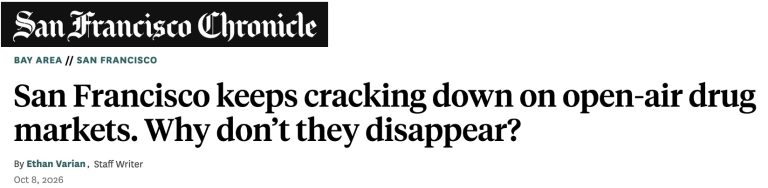
In a less dysfunctional culture, that headline question would be recognized as rhetorical, because it would be rhetorical. We know exactly why high-risk opioid and other drug use persists unabated in SF, explained effectively, for example, by local sources in Columbus, Ohio, in the news video embedded in this post.
Check the date of that Chronicle report, quite recent, published as experts point to fatal opioid ODs having declined as evidence of a moderating crisis due to decreasing high-risk use. We already knew that’s not true, that all drops in deaths are attributable to intensively expanding naloxone campaigns, in SF, in California, as everywhere.
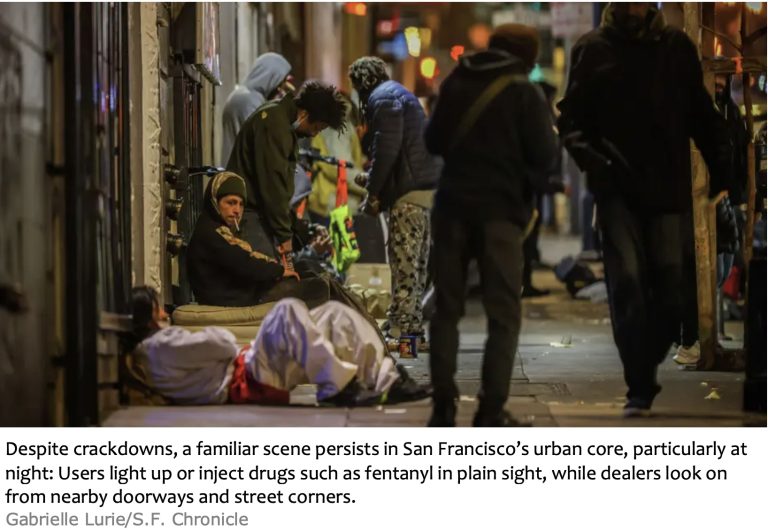
Check the caption under that image. Someone felt unconstrained from conveying the obvious: the persistence of high-risk use.
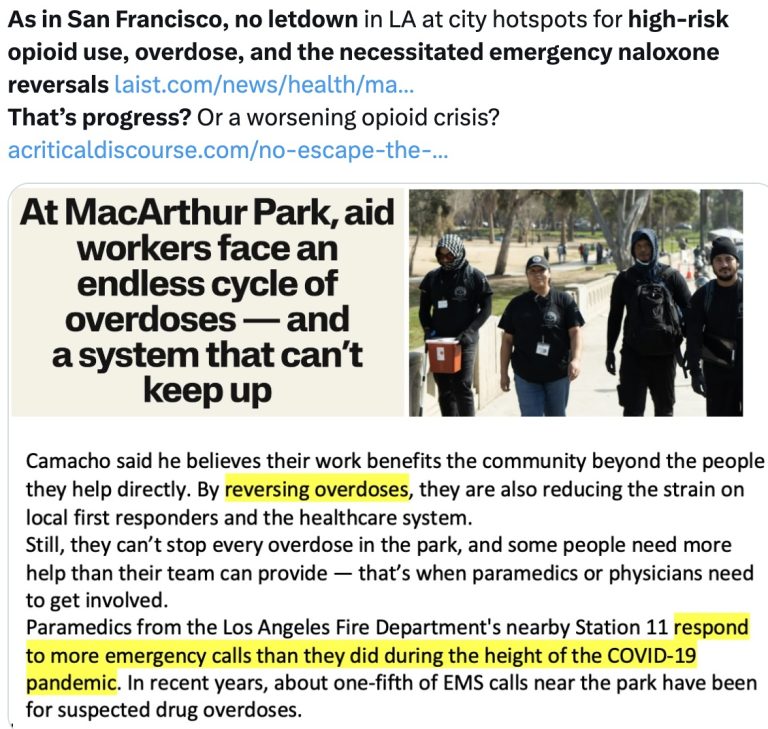
That description (along with those from San Francisco city officials, below) is similar to language in a more recent report describing the same, unabated high-risk use in Los Angeles hot spots, “an endless cycle of overdoses”.
My take at X –
Even San Francisco city officials are finding it hard to keep mending rips in the Matrix. From the Chronicle news piece –
“I’m not hearing (from constituents) that things are better than they were five years ago,” Supervisor Jackie Fielder, who represents the Mission, said at the public meeting. “I’m hearing that things are getting worse.” …
In a social media post this week, Lurie said he recently went for nighttime ride-alongs with police through SoMa, the Tenderloin, Nob Hill, Hayes Valley and the Mission. He said there were “bright spots,” including 24th and Mission streets, but that “it’s clear that fentanyl remains a crisis in our city.”
[emphasis added]
Maybe it’s just California having problems? Or not.
In Kansas local reporting, below the headline heralding a drop in fatal opioid ODs –
this, from the Director of the local public health center –
“We are still seeing that opioid like ER visits associated with opioid overdose and hospitalizations, those are still either staying steady or on the increase, so that doesn’t necessarily mean that opioid use is going down.”
And in Minnesota, from a report published in October, 2026 –
“demand for treatment services is higher than it’s ever been … [Narcan is] not necessarily stopping the level of addiction, but it’s decreasing the fatalities”
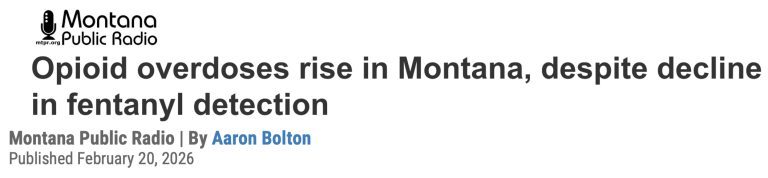
The same observations are found in reports this year from Montana –
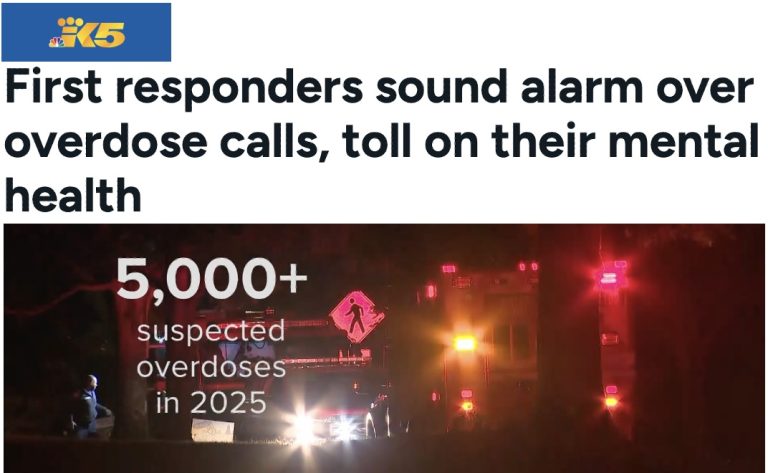
SEATTLE — First responders are confronting a growing challenge on two fronts: responding to an increasing number of calls about drug overdoses while dealing with the mental and emotional toll of the work. …
In Seattle, fire crews responded to about 5,000 suspected overdoses last year, up from just over 3,500 in 2021 and it comes with other challenges.
“Overdoses happen much quicker, more regularly, and they take more to reverse”.
Counties in Michigan and in Wisconsin are reporting surges in opioid overdoses.
And in Pennsylvania, centered in Philadelphia –
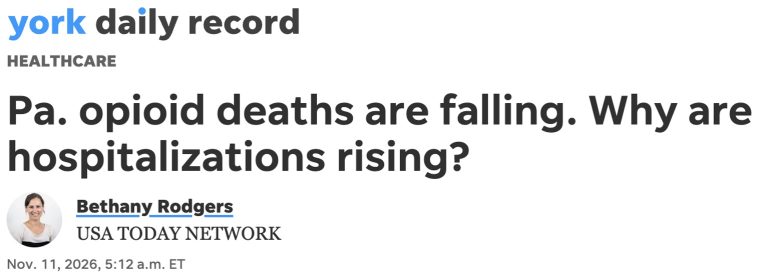
Opioid-related hospitalizations in Pennsylvania are rising despite a drop in overdose deaths.
Experts attribute the spike in hospitalizations to the veterinary tranquilizer medetomidine lacing the fentanyl supply.
Medetomidine causes severe withdrawal symptoms that often require extended stays in intensive care units.
The surging hospitalizations are tied to high-risk fentanyl use.
Those rising hospitalizations are tied to high-risk opioid use, and persistently high-risk opioid use is a valid measure of failure of expert treatment and prevention approaches.
The examples here of persistent and surging opioid high-risk use and overdose do not themselves establish a worsening crisis. They, instead, illustrate and represent an accurate, snapshot chronicle of a worsening crisis established by longstanding reinforcing lines of evidence that identify expert, gold-standard approaches as predictably failing and fueling the epidemic.
Because an uncontrolled epidemic of desperate and deadly use of pain-numbing opioid drugs is just the most visible of America’s lethal crises of drug misuse, suicide, depression, of obesity and sickness, of social illness. Because the matrix of health experts and institutions constructed and identified by mass media as trusted authorities – publicly funded and entrusted to protect public health – instead collude to fabricate false assurances like those that created an opioid crisis, while promising medical cures that never come and can never come, while epidemics worsen. Because the “journalists” responsible for protecting public well-being have failed to fight for truth, traded that duty away for their careers, their abdication and cowardice rewarded daily in corporate news offices, attempts to expose that failure and their fabrications punished.
Open, critical examination, exposure, and deconstruction of their lethal matrix of fabrications is a matter of survival, is cure for mass illness and crisis, demands of us a critical discourse.
Crisis is a necessary condition for a questioning of doxa, but is not in itself a sufficient condition for the production of a critical discourse.