As consistently across the U.S. – in Ohio naloxone accounts for death reductions; high-risk opioid use is unabated; and highly variable outcomes across locales nullify expert explanations
by Clark Miller
Published November 6, 2026
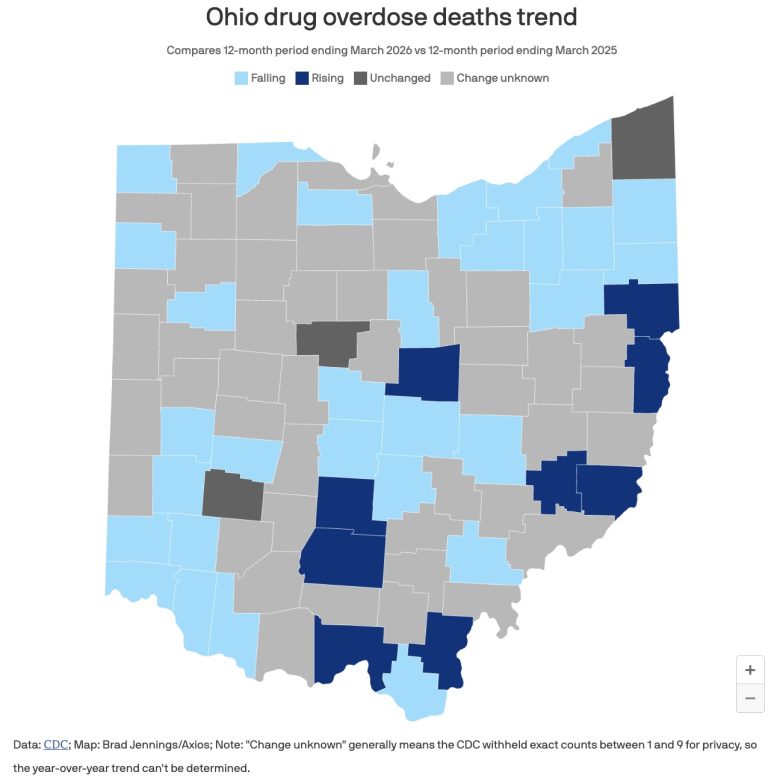
That interesting graphic comes from this recent piece in AXIOS. Here’s an enlarged view of the key –
Drug overdose deaths are falling sharply in Butler and Warren counties, new CDC data shows. It’s the continuation of a yearslong turnaround in a region once devastated by the opioid epidemic.
Okay. But forget Butler and Warren counties. They’re not the story here.
And the most important part of the story is not to be found in the AXIOS report. It’s what we know already – that consistently, across states, regions, locales, counties, and cities in the U.S., reductions in opioid overdose deaths are accounted for entirely by the emergence of effective naloxone campaigns, and the relative magnitude of those drops, or their absence, correlate with the effectiveness and intensity – or delay or failure – of those campaigns and their timelines.
That’s been true in Ohio as well as elsewhere, detailed in posts here
He [Jordan Meyer, a senior epidemiologist with the Butler County General Health District’s Division of Community Health Services] says wider access to naloxone, commonly known as Narcan, has been especially important.
The overdose-reversal medication is now available through vending machines at gas stations and convenience stores, shelters, meal centers and treatment facilities.
“There’s a lot more collaboration that we’re noticing within the county and just more awareness of naloxone and how to prevent overdoses,” Meyer tells Axios.
[emphasis added]
As is this.
The bottom line: Meyer says overdose-related hospital admissions are also declining, but people are still struggling with addiction and need support.
“Just because we’re seeing the reductions doesn’t mean that the problem is fixed,” he says. “There’s still people who are struggling.”
[emphasis added]
Those comments, like Meyer’s above regarding the role of Narcan (naloxone), are accurate and important as far as they go, and lethally inaccurate in not capturing the whole truth.
Naloxone campaigns are not only “especially important”, but are established as entirely accounting for opioid fatal overdose reductions. Measures like “overdose-related hospital admissions” are established as becoming increasingly inaccurate, underestimating opioid overdoses (thereby high-risk use) as naloxone campaigns have increasingly shifted reversals to community locations, by laypersons, thereby unreported.
As described in detail in this important, anomalously accurate media report from late 2024 in Columbus, Ohio, direct-service providers see the real picture: persistently surging high-risk opioid use and overdose, despite intensive naloxone distribution and serial saves that go unreported, hiding a worsening crisis. That report is placed in broader context in this post.
And the main takeaway, already established and known to us, is not in the written AXIOS report, but in the remarkable impression conveyed by the graphic of Ohio counties we started with – in the radical heterogeneity of county outcomes: some counties with decreases in OD deaths, with magnitudes varying widely, others with increases, others without change.
Because an uncontrolled epidemic of desperate and deadly use of pain-numbing opioid drugs is just the most visible of America’s lethal crises of drug misuse, suicide, depression, of obesity and sickness, of social illness. Because the matrix of health experts and institutions constructed and identified by mass media as trusted authorities – publicly funded and entrusted to protect public health – instead collude to fabricate false assurances like those that created an opioid crisis, while promising medical cures that never come and can never come, while epidemics worsen. Because the “journalists” responsible for protecting public well-being have failed to fight for truth, traded that duty away for their careers, their abdication and cowardice rewarded daily in corporate news offices, attempts to expose that failure and their fabrications punished.
Open, critical examination, exposure, and deconstruction of their lethal matrix of fabrications is a matter of survival, is cure for mass illness and crisis, demands of us a critical discourse.
Crisis is a necessary condition for a questioning of doxa, but is not in itself a sufficient condition for the production of a critical discourse.