AN OREGON TELEHEALTH TURF WAR EXPOSES A FAILED MENTAL HEALTH SYSTEM
Yes Oregon, out-of-state, unlicensed, unqualified “therapists” running virtual peer treatment groups predicts harm – as does your own lethally failed cronyism system
by Clark Miller
Published September 4, 2026
Charlie Health is a dangerous, harm-predicting scam. That is to say, it is an opportunistic, wildly successful healthcare entity in America.
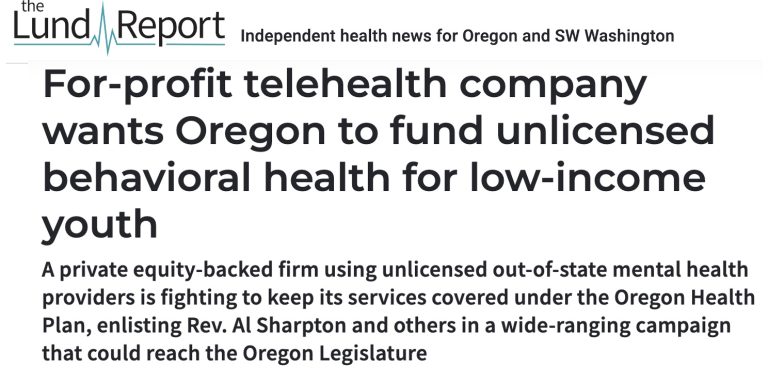
A Montana-based remote mental health services company has hired lobbyists in Salem and enlisted civil rights leader Rev. Al Sharpton to try to override a push by the Oregon Health Authority to block the company from serving low-income youth using unlicensed providers.
The debate pits concerns over access to care against concerns about the quality of care provided to vulnerable youth. The company, however, claims the state agency is merely acting as a proxy for “vested interests,” referring to the insurers and nonprofits that provide services to low-income members of the Medicaid-funded Oregon Health Plan
The company almost succeeded in getting a bill issued on its behalf in time for the short legislative session that starts Feb. 2. Lobbyists had persuaded Rep. Rob Nosse, the chair of the House Health Care Committee, to commission a bill on the firm’s behalf, but he has paused his efforts since learning more of what’s driving state regulators’ concerns — including that the firm has allegedly resisted state oversight and also employs providers who have unclear credentials and no license or certification to practice in Oregon.
“If Charlie Health is using unlicensed people from other states here in Oregon, then that is likely a problem,” Nosse wrote in a Jan. 5 email to the company’s representatives explaining why he was reconsidering sponsoring a bill on the company’s behalf.
Oregon Health Authority is right to challenge the operation of Charlie Health, providing virtual-only behavioral health sessions to vulnerable Oregonians, but for the wrong reasons.
The concern is not that the Charlie Health facilitator/counselor sitting somewhere and connecting to clients via a Zoom-like platform is not licensed in Oregon. That licensure would guarantee little to nothing regarding quality of care provided, something I attest to with confidence and based on direct observations, having been immersed in a broad range of Oregon’s behavioral health systems for longer than 2 decades.
Programs and systems awarding professional degrees and licensure in America’s behavioral health field, in any state, do not endow recipients with competence, let alone provide and enforce continued assurance that they have been prepared to avoid doing harm.
It is that generalized, careless, maleficent abandonment of standards of competence and care and essentially everything else about what Charlie Health is doing, about “telehealth” itself, and about practices at the core of telehealth and in-person mental health services in Oregon and elsewhere. Co-opted over past decades by medical, cost-reducing, and authoritarian models of healthcare, it is, essentially, all bad, all failed, and all harm-predicting.
Okay, let’s start with a reality check.
I’ve worked as a psychotherapist for a little more than 2 decades, and like other clinicians entering private practice, I considered for use a number of top (by market share) internet-based practice management platforms, those platforms described, for example, as serving as many as “over 250,000 clinicians and 16 million clients and offering integrated EHR, scheduling, billing, and telehealth”.
I started in private practice right as COVID broke, during the upheaval that generated radical changes in how healthcare services could and would be provided. Among the platforms I was looking at, one had generated a consent form template for use by clinicians in its library of standard forms that clinicians might use as intake documents with new patients starting services. It was a new informed consent form for use of telehealth (aka “telemedicine”, “telemental health”, etc.), a term that describes connecting with patients virtually, over phone only or synchronous audio and video connection via a HIPAA compliant (secure) platform. That is, the modality by which counselors working for Charlie Health exclusively connect with their clients, virtually.
It would be difficult to overstate the ethical and clinical import of the provision of informed consent to patients. It is “fair warning” of the potential risks and benefits of any healthcare procedure or interaction, provided, first of all, to protect patient safety and well-being. Informed consent is, for example, what American licensed medical prescribers were failing to provide to their patients as they fueled the opioid crisis.
Here’s an excerpt from one of those practice platforms available to independently practicing clinicians – the first paragraphs – from the standard template offered to clinicians using that practice platform to provide informed consent for telehealth services –
CONSENT FOR TELEHEALTH CONSULTATION
- I understand that my health care provider is providing the option to me to engage in a telehealth consultation. I understand that a telehealth interaction does not constitute psychotherapy or counseling or the evidence-based benefits of psychotherapy or counseling. Instead, it provides under time-limited, exceptional circumstances the opportunity to access supportive communication and exchange of information that may benefit my functioning and sense of well-being and provide information to my provider that helps to assess my needs and concerns and understand my status. As such, it may be reimbursed differently by my insurance payer than therapy sessions.
- My health care provider explained to me how the video conferencing technology that will be used to affect such a consultation will not be the same as a direct client/health care provider visit due to the fact that I will not be in the same room as my provider.
- I understand that a telehealth consultation has potential benefits including easier access to care and the convenience of meeting from a location of my choosing.
…
Prospective clients who may access telehealth sessions would be required to read, sign and date the consent form in order to engage in telehealth services, as for any other aspect of provision of healthcare.
Let’s think about this just a minute. Telehealth “does not constitute psychotherapy or counseling or the evidence-based benefits of psychotherapy or counseling.”! Then why are we providing it? Why is it allowed when there could be a return to real therapy? We’ll get to all of that.
You see, it’s more than just patients being protected. Short version: when it becomes apparent, when it is exposed, that this absurd pretense – that interacting virtually, via electronic device screens, could remotely (no pun intended) serve as a substitute for in-person therapy – is without clinical, research, or ethical validity, then for my protection I (your therapist) will have your signed consent that you understood that risk and chose to proceed. You signed it! I’m protected. Just not my conscience, for billing for sham therapy as if it were real.
Funny how the cynical view seems so often to be the accurate one.
So, what happened when COVID blew up and telehealth became normalized?
For several therapists in private practice I knew, it was an opportunity for personal advantage. Like a gift. Work from home and save $1,500 monthly by giving up an office space? Damn right. It’s not therapy, which the patient is deprived of, but … nobody’s stopping me.
No clinically and ethically competent therapist sees telehealth as real therapy, leaving a very large workforce to jump right in and provide it.
In the hysteria and panic of COVID onset and the hidden culpability for it, there were more pressing needs than the well-being of mental health patients or kids in school. The fabricated validity and celebration of telehealth and virtual learning was a necessary distraction and compensatory performance of the appearance of competence for top public health officials in desperate need of distractions, including from the school disruptions that were unnecessary and more harmful than beneficial, and a distraction from the clear evidence that COVID itself was of their doing, a U.S. bioweapons lab leak.
There was, as well, a desperate need to protect the pretense that telehealth, including virtual connections for dispensing of addiction medications, for substance use treatment, and support groups, was absolutely necessary to provide continuity of those “treatments”, as if those sham treatments and services were providing benefit, rather than harm.
Those remain needed discussions of lasting failures yet to be faced.
Patients seeking real therapy know what they need
In my practice, I continued to use my office space for in-person therapy sessions throughout the COVID episode. The exceptions were in order to serve patients for whom it became practically impossible to access competent behavioral health care without use of telehealth – after moving away, due to material or financial strain, or unable to access competent care in their area.
For in-person sessions, and the exceptions needing a remote connection, there have been almost no patients in my practice wanting to use telehealth for lack of recognition of any difference compared to in-person sessions, instead the opposite, patients almost all able to articulate their understanding that a virtual connection is not real therapy, is not a real human connection.
They “get it”, but it’s more than just that, more than understanding the difference. Related to various circumstances, very few of my patients are “mandated”, that is, forced, or coerced at risk of severe consequences to access and engage in therapy services by a court or, for example, a child protective services agency. Patients I see almost always engage in therapy out of internal motivation to gain relief from some condition or symptoms, to change something not working well in their lives, NOT for the sake of compliance with criminal justice, juvenile justice, or child protective services mandates that would enact punishments for lack of compliance. The patients I see are interested in real, in-person therapy because they want personal growth and change.
It is no coincidence that the target populations for Charlie Health seem to be mandated clients – related to juvenile justice problems, juvenile school problems, criminal justice, child protective custody, and substance use. They don’t need real therapy to comply with conditions imposed to regain contact with their children, for example.
As we’ll soon see, Charlie Health does not provide psychotherapy. Their clients are not seeking real therapy. They are seeking avoidance of therapy, which can be challenging, uncomfortable, demanding. And in real, in-person therapy sessions, or real in-person group therapy sessions, there isn’t the option of discreetly going off-screen to take a hit off your vape, or to keep up with the texting you’re doing.
Let’s get more clinical
Effective work in psychotherapy relies on the competent use by therapists of “evidence-based” models, strategies, and techniques for interacting with patients in ways that relieve symptoms and help them reach their goals. Evidence-based means that over time, many years, high-quality research studies (randomized and controlled, with internal and external validity) have been carried out, evaluated, and replicated, the cumulative outcomes over time pointing to consistent, statistically significant, valid outcomes of benefit to clients.
Findings of benefit can, of course, only be considered valid for the conditions the studies were undertaken in.
Telehealth and virtual therapy using remote audio/video connection began about 5 years ago. There are no – NONE – bodies of evidence with replicated, high-quality studies that are valid for that radically different modality.
The variety of psychotherapy models that can be considered evidence-based (CBT, DBT, ACT, psychodynamic, motivational interviewing, interpersonal therapy, and numerous others) are so only because there are large bodies of replicated studies with cumulative, valid outcomes of benefit. Those have been studies of therapy provided over decades, in person, face-to-face, not screen-to-face.
It’s that simple. There are no evidence-based therapies established for the virtual setting, a modality and form of human connection radically different from in-person, face-to-face interaction.
That hasn’t stopped Charlie Health from freely using the term “evidence-based” to describe and promote their practices.
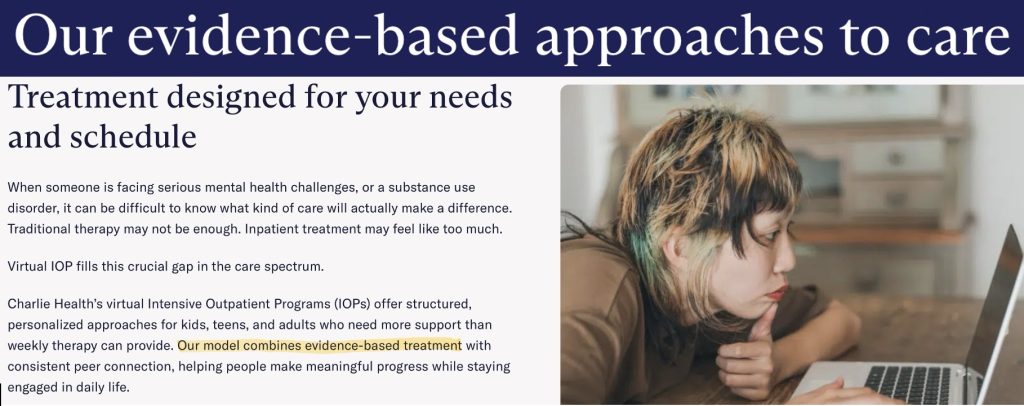
Are the therapy models listed at the Charlie Health website evidence-based? Yes, at least some are, and they are only for the conditions under which outcomes of benefit were established in the necessary body of replicated studies to support that conclusion: individual in-person psychotherapy. For Charlie Health’s claims to be accurate, they would have to be described as “our approaches that are established as evidence-based when provided in in-person therapy sessions”.
Is Charlie Health lying? Whether intentionally deceiving or malignantly clueless, the predictable outcome is of very vulnerable populations being deprived of what they need – real evidence-based therapy delivered by competent (providing in-person, individual therapy) therapists.
Healing is relational, not virtual
The variety of evidence-based psychotherapy models alluded to so far, validated as beneficial only for in-person sessions, are considered to be the “specific factors” and are, as it turns out, valuable and yet less predictive of patient success in therapy than a qualitatively very different evidence-based therapy model, the “common factors approach” or “contextual model of psychotherapy”. That model, moreover, is considered foundational for the success of the specific factors. It is a central concern in any consideration of the lack of evidence for ethical use of virtual therapy, apart from circumstances offering no other alternatives.
While the specific factor therapy strategies and techniques rely on understanding and skill in how to use language, forms of questions and discourse, and strategic communication skills to help patients gain insight, confidence and motivation for change, common factors approach goes deeper, to the core of what allows specific factors and therapy to work.
That sounds important, doesn’t it?
And interestingly, perhaps not surprisingly, the power and effectiveness of the common factors approach (aka “Contextual Model“) is all about the intangibles, the things that are potentially felt and experienced in the therapy space that are real yet harder to articulate. The vibe, the feel that we get when interacting with any other human, close up, face-to-face.
One way of thinking about all of this is to consider the dictum, that the specific factors are what a therapist does, and the common factors are who the therapist is. That factor – how it feels to be in interactions with a unique therapist, that real person, what comes across from subtle cues that we are hardwired to pick up on when we can, when we are in close proximity and able to clearly perceive nuances in facial expressions, tone of voice, etc., etc. that provided a sense, a vibe of, a space within which a patient feels deeply attuned to, seen, and interacted wtih nonjudgmentally and with unconditional positive regard – is one of several supported by reasearch as most stroingly predicting success in therapy.
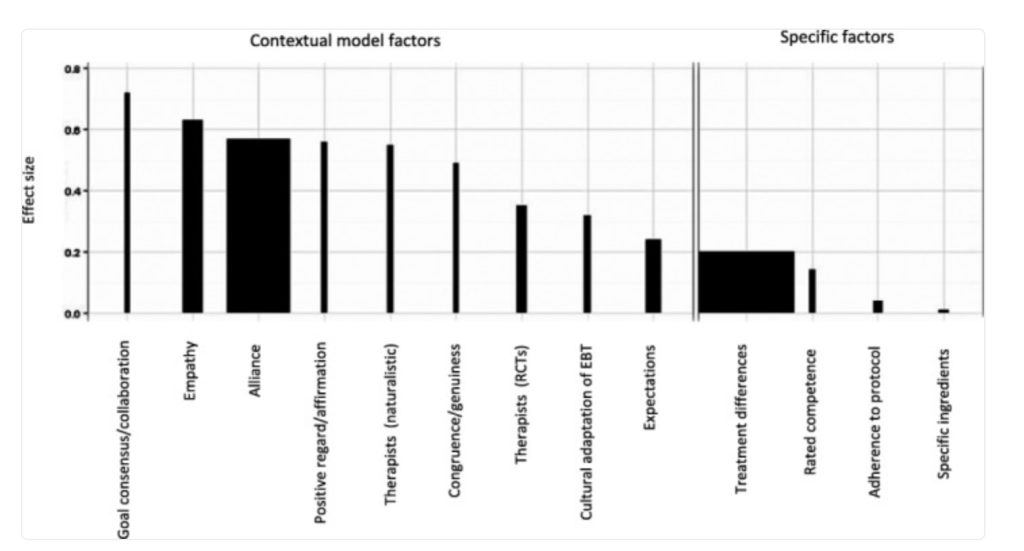
Figure 1. Effect sizes for common factors of the contextual model and specific factors. Width of bars is proportional to number of studies on which effect is based. RCTs – randomized controlled trials, EBT – evidence-based treatments
Supported by 10 million years of research and development
A couple of main takeaways emerge from the attention we’ve given to the common factors approach and what its research base means for psychotherapy and for virtual “treatment”
First, a reminder that the evidence supporting it is longstanding, integrating large diverse bodies of research over decades, all of it applying to and validating the fundamental importance of the factors in settings of in-person therapy.
Takeaway 1
There is no body of evidence allowing evaluation of the effectiveness of common factors (or the specific factors, like those employed in CBT, DBT, other models) for virtual therapist-patient interactions. That’s important and invalidates any claims to the contrary.
Takeaway 2
We don’t need to rely entirely on formal research studies to predict and know with confidence that the common factors must be not just needed and important but also potentially effective and beneficial in in-person therapy settings and not in virtual interactions.
That’s because we have 10 million years of research and development revealed to us in fields including theory of evolution and natural selection, evolutionary psychology, human development, sociology, interpersonal psychology, and others as well as our own daily personal experiences to consistently and congruently reinforce those conclusions.
We have the high-acuity, high-sensitivity perceptual, cognitive and emotional response capacities to gauge the meaning of subtle physical, facial, verbal, and other cues evidenced by others hard-wired into our psyches and running by default precisely because of their survival value for our hominid and prehominid ancestors and their offspring over millions and millions of years.
When those capacities led to accurate judgments of the intentions of others along gradients of friend or foe, reliability, trustworthiness of mate, responsibility and capability in cooperative offspring protection, trustworthiness in veracity, benign or beneficial use of resources openly conveyed to the other, incuding communicated information, commitment and cooperation in protecting our own survival, and other aspects supporting survival, then those genes were passed on. And with inaccurate estimates of those qualities of the other, our genes much less likely to be passed on.
Let’s bring in “common sense” and personal experience.
How do we come to explanations for established understandings that as little as 7 percent up to 40 percent of what is conveyed in human communication is verbal, versus non-verbal, “verbal” referring to the literal, dictionary-defined meanings of the words uttered. The remainder, up to 90 percent or more, is conveyed by non-word utterances and other forms of non-verbal communication.
Why, for engaged, thoughtful, authentically feeling viewers, does the remarkable film “Up in the Air” resonate so strongly as expressing important truths to us?

COVID – a nationwide natural experiment for remote, virtual learning
More concretely and powerfully, we are compelled to wonder about and inform ourselves from the outcomes of the very large, natural virtual learning experiment that delayed and harmed young people – the population preyed on by Charlie Health – when their schools were shut down over pandemic years.
Let’s just outline some examples of how we’ve been viewing the unnecessary mass disruptions and displacements over COVID years of students from their classrooms, from direct interactions with teachers to remote screen learning.
Abstract
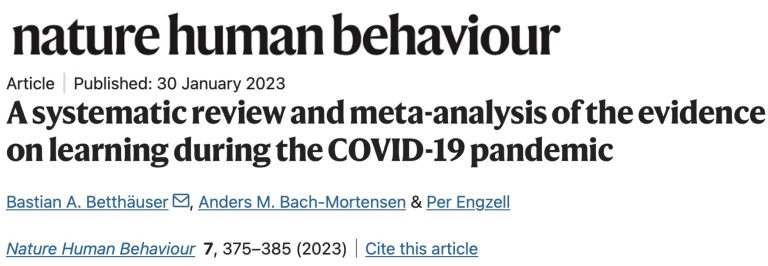
To what extent has the learning progress of school-aged children slowed down during the COVID-19 pandemic? A growing number of studies address this question, but findings vary depending on context. Here we conduct a pre-registered systematic review, quality appraisal and meta-analysis of 42 studies across 15 countries to assess the magnitude of learning deficits during the pandemic. We find a substantial overall learning deficit (Cohen’s d = −0.14, 95% confidence interval −0.17 to −0.10), which arose early in the pandemic and persists over time. Learning deficits are particularly large among children from low socio-economic backgrounds. They are also larger in maths than in reading and in middle-income countries relative to high-income countries. …
[emphasis added]
HOW COVID-19 AFFECTED EDUCATION
The Covid-19 pandemic has had a wide-ranging and long-lasting impact on education in the United States. Not only are students still contending with years of learning loss, but they also must rebound from the disruption to their social and emotional development. …
KEY FINDINGS ON THE LEARNING LOSS DUE TO COVID-19
Key findings from the most recent school year available (2021–22) include:
- In 2022, only 26% of eighth graders were at or above proficient in math, much worse than before the pandemic (33% in 2019).
- Less than a third of fourth graders (32%) were at or above proficient in reading, two percentage points lower than right before the pandemic (34% in 2019).
- Thirty percent of all students (14.7 million students) were chronically absent, nearly double pre-pandemic rates(16% in 2018–19, the final school year fully unaffected by COVID). Two out of three students attended schools plagued by chronic absence.
- Four out of 10 (40%) had undergone at least one adverse childhood experience (ACE), such as family economic hardship or their parents having divorced, separated or served time in jail.
Were the student populations and circumstances over COVID disruptions by remote learning just the same as for the type of provision of remote therapy by Charlie Health? No.
Are there differences between the provision of school lessons and instruction and the provision of therapy and counseling? Yes.
And, there are important things to learn from the unfortunate outcomes of COVID shifts to virtual classrooms.
There were broad, negative effects for students, most importantly, generally, and fundamentally, reflecting diminished effectiveness of conveyance to them of valuable comprehended meaning in interactions with the communicator (teacher in their case).
Those differences and losses would be expected to be heightened in the virtual therapy setting, in which conveyance of nuanced meanings and expressions of non-verbal meaning are a critical part of success of the process, critical as well the grounded, undistracted attention to inner material (thoughts, memories, emotions) by the client.
Put simply, virtual, remote connections add distance, distortion, and disengagement that, based on COVID outcomes, generate attentional, motivational, and/or other blocks to needed gains.
And? From those complete reports, the more vulnerable, already distracted and disadvantaged by stressors, and/or affected by emotional and mental disturbances, the more predictably the young persons will be harmed by the inadequacy of virtual connection, like Charlie Health’s victims.
That should tell us something.
So, let’s take a broader look at what Charlie Health is about, obligated to by our disappointment that they have lied about their program providing “evidence based” therapies to high-risk, vulnerable youth. It doesn’t.

So, what about group therapy, the mainstay of Charlie Health programming?
Group therapy is not just the mainstay (and income generator, as we’ll see) of Charlie Health programming but, in fact, of the U.S. “addiction” treatment industry and, of course, of the bizarre, harm-predicting religious subculture that hundreds of Americans are by legal coercion forced into daily, predicting harm and return to problem substance use.
We could drill down on the lack of research evidence supporting beneficial effects for group therapy, but that’s not necessary.
All we need is a very basic familiarity with what is established about behavioral health conditions and their treatment, and a willingness to think about that.
Remember the ACE study we’ve considered and the effects of ACE? For individuals seeking therapy and those not, ACE are a very common part of their lives. Especially for the vulnerable, high-needs youth population Charlie Health has been preying on, multiple ACE are almost predictable, including experiences that legitimately count as “trauma”.
Effective, evidence-based therapies for PTSD, anxiety disorders, depression, and other mental health disturbances generally, are validated for in-person, individual sessions. Period. Not for group sessions.
There is some evidence for the value of providing skills training (communication, interpersonal, anger management, others) in in-person group settings, benefits largely attributed to the natural opportunities in groups to practice and role play the skills with others like and unlike oneself, with feedback and support from a competent therapist.
That potential benefit is negated, of course, for virtual group settings, for the obvious reasons, including that without the full range of verbal and nonverbal elements of communication (the interactions between 2-dimensional headshots on a screen), there simply is no possibility of practicing the behaviors. It’s a bit like trying to have a date, or a romantic evening with someone, by virtual connection.
(If humans are ever somehow prevented from engaging in any in-person, face-to-face interactions and forced to interact only virtually, through their screen images and audio, then of course these screen skills will become very important to learn, and we will be grateful for the foresight of the developers of programs like Charlie Health.)
Group therapy is “not a thing”, is simply not a substitute and not supported or indicated for work on mental health needs, with limited exceptions as noted, and with no indication of benefit when provided virtually. Then how is it possible that group therapy would come to dominate services provided in U.S. substance use treatment systems and be common elsewhere, including in virtual programs like Charlie Health?
That’s the easy one. Think about it.
Just for starters. A behavioral health agency generates income that is the difference between what they pay a therapist for each session billed and the amount they can bill (often public) insurance for the client’s session.
A group session is composed of one therapist and anywhere from 4 or 5 to 10 or even more clients.
Do the math.
As importantly, historically and continuing currently, the provision of group therapy, especially in substance use treatment programs, has been by individuals grossly unqualified to competently provide any types of therapies, let alone for complex, life-threatening mental health conditions. That explains U..S. mental health population outcomes and trends over past decades, including in Oregon, our state of interest.
Those “therapists” would not succeed in private practice, and are relegated to working in America’s behavioral health systems, where they are provided a low salary to provide substandard services and to never deviate from the pretense that those agencies and programs are providing competent services legally and ethically to vulnerable clients. They have their positions of employment because they are willing to do that, and because they are capable of sitting in and leading group sessions by asking questions like, “What does the group think of what Tony just said?”
If they are employed in the substance use treatment field, then they have less than inadequate competence; instead as acolytes in the bizarre religious subculture AA (or NA), they are predestined to do harm to the vulnerable clients they are paid to serve, by endorsing healthcare misinformation and bringing to group practice the prescriptions and harm-predicting precepts of AA culture, which predicts failure at rates of 85 to 95 percent.
But they are protected, as is the culture of group therapy that has no treatment value, but something much more important – a protected place for these members of the cronyism system that has always run U.S. substance use treatment systems and U.S. substance use treatment policy.
If this seems less than credible, take the time to selectively read from these posts describing the role of this cronyism system in the background and history, in clinical and policy formulation, and in the predictable failure of Oregon’s decriminalization measure.
Charlie Health, by the way, is now poised to greatly expand it’s services to provide virtual group “therapy” focused on substance use treatment.
Enough about group therapy.
Okay, not quite.
Charlie Health’s “individualized” one-plan-for-all treatment
That’s right, Charlie Health is branding itself with more lies. You were expecting something different?
To digress briefly, individualized treatment is the touchstone of competent, ethical behavioral health provision, because therapies are never treating a condition; instead are infinitely malleable modalities, ways of interacting, with a specific, unique client, a person, to identify, explore, gain insight about, question, and change the entirely unique collection of beliefs, memories, emotional vulnerabilities and wounds, and other parts of self that are self-defeating or otherwise associated with life problems and undesired emotional states and traits. Another way of seeing that is to say that no two treatment plans would ever be the same for any two individuals, will always be as unique as the individual and their reasons for coming into therapy. That applies to what therapy approaches are used, as well as the level (frequency) of therapy sessions.
Treatment that is not individualized is not treatment for a client.
Tightly associated with that fundamental obligation and equally a touchstone is “client-centered treatment”, meaning that the goals worked on in therapy come from the client, are what the client wants from therapy, not from anywhere else. As an ethical standard in behavioral health, that applies to adolescents and teens as well as adults.
Here’s how Charlie Health promotes the image of its commitment to individualized treatment –
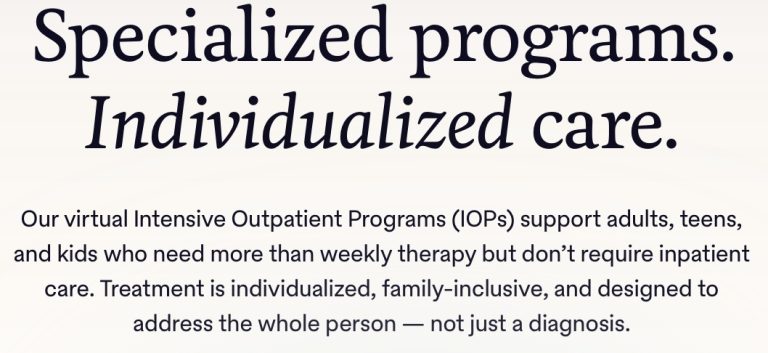

So you see? The treatment provided to each client at Charlie Health is not just Individualized, it is hyper-personalized.
We also learn, at the hyper-attractive Charlie Health website, that they treat the unique needs of teens. That’s interesting. There apparently are some unique needs for teens that teens should be treated for. Individualized and the same unique needs for each and every teen? (See how I did that?)
I’ve observed and worked in many programs that treat adults, but have never seen the expressed claim, meant to be appealing and confidence-building, that “we treat the unique needs of adults”. Something to think about.
We could double the length of this post deconstructing more of what Charlie Health tells us about Charlie Health on their website, including bogus claims for successful outcomes. But we won’t. For now.
Let’s just selectively and briefly hit a couple of main points.
The population Charlie Health is fighting over in Oregon is described as high-needs youth with serious mental health and behavioral disturbances. A large share are covered by Medicaid, which reimburses at high rates in Oregon and covers individuals who are not able to be covered by commercial insurance. This population has very high incidence of childhood trauma or ACE.
The indicated, needed therapies are those provided by a competent therapist in individual sessions, successful therapy beginning as the young person over an extended period of time gains a sense of trust and safety with the therapist. Potentially.
Often, more than one session weekly is needed and indicated, and will be covered by insurance. As we’ve seen, there is no benefit from virtual group sessions, and group sessions can activate trauma-related flight or freeze reactions in many youth, the group session not a setting to manage or work on that, instead individual sessions. And for most youth, or anyone who has been affected by trauma, the least likely setting in which they are likely to feel comfortable openly working on those experiences is in a group of individuals they have never met. Openness comes, if it does, in the development over time of trust and safety in the familiarity with a professional who is committed to protecting privacy and emotional safety.
If Charlie Health were providing the therapy needed, that would be more than one, up to several individual sessions per week and by allowing each client to choose or decline group sessions.
That’s not going to happen at Charlie Health, where the IOP level of care is universally applied to each and every young person, comprising by definition 1 individual session per week and 8 1-hour sessions of group therapy, with no predicted benefit. Except for the benefit for Charlie Health, which bills each time a group session is competed for 6, 8, or 10 or more clients in the group, run by one “group facilitator”.
That’s how it works, Charlie Health’s lucrative version of individualized treatment.
Part of those 8 weekly hours of group therapy is “family therapy”, not because it was chosen by each youth client, but from all appearances, predetermined for everyone, not individualized at all.
Having worked as a child and adult therapist for a couple of decades, I can say with confidence that what many of those youth clients need help with is being protected from their families, not making nice in a therapy session. They are in therapy almost invariably related to the ways they were abused, neglected, emotionally or otherwise harmed within their own families.
To make gains against emotional injuries, exposure to drug use and violence, or worse, they typically need at least help in viewing their experiences and their families realistically, gaining assertiveness and boundary-setting skills, improving their sense of self, and relearning healthy and self-protective interpersonal skills.
Sessions with family members may be therapeutic – if that is something they want. Assuming without their consent that they do, or requiring family sessions or any other types of sessions other than offered individual therapy, is the antithesis of individualized treatment and potentially places them at higher risk.
That’s enough for Charlie Health, which, after all, is simply a symptom, a metastasis of the pathology driving behavioral health systems and practices generally.
And possibly not anywhere more so than in Oregon.
For derelict, harm-predicting services, even Charlie Health can’t top Oregon
Charlie Health is bad, predicts harm, should never have had the opportunity to arise, and yet cannot rival Oregon’s longstanding status at or near the bottom of all U.S. states for mental health, substance use, and opioid crisis outcomes.
Their battle over telehealth turf is like … like … I don’t know, like any two criminal elements fighting over turf, over vulnerable, injured individuals to sell something broken and useless to.
How bad is Oregon? Here’s a recent news account of how one of Oregon’s coordinated care organizations (CCO) allocated $millions in state Medicaid funds for substance use treatment while Oregon’s opioid crisis metrics continued to tank. In woke, progressive, liberal Oregon.
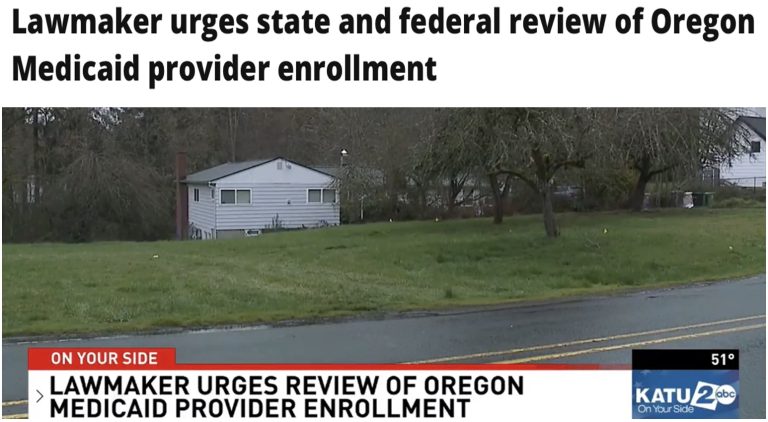
LAKE OSWEGO, Ore. (KATU) — Oregon Rep. Ed Diehl, R-Stayton, is once again urging the Oregon Department of Justice and the U.S. Department of Health & Human Services to investigate reports of Medicaid fraud and mismanagement across the state.
His requisition comes three days after the U.S. House Committee on Energy and Commerce sent a letter to Gov. Tina Kotek, D-Oregon, and ODHS Director Lisel Wendt, demanding information “related to program integrity and fraud, waste, and abuse (FWA)” in Oregon’s Medicaid program, also known as the Oregon Health Plan. …
The committee informed the governor and Wendt that they found “recent fraud investigations and convictions related to Oregon Health Plan [that] are concerning.”
Among other reports, the letter cited a request from Diehl to the Oregon Department of Justice and ODHS last year for an investigation into Uplifting Journey LLC, a sober living facility in Lake Oswego that opened in 2023. Diehl said the facility was reported to have received more than $2.3 million in Medicaid funds in under one year, while allegedly housing Tren de Aragua (TdA) gang members involved in serious crimes.
One of those alleged members is reported to have been arrested for kidnapping and attempted murder of a woman in Washington. Court documents connected them to the facility in Lake Oswego.
Diehl wrote to the Oregon Department of Justice and ODHS in September.
“Despite multiple red flags — including repeated police calls to the property, violent criminal charges, and reports of fraud — the Oregon Health Authority (OHA) appears to have taken no effective action. Its offices certified the company, processed daily reimbursement claims, and then offered contradictory statements about whether any enrollment agreement even existed,” he wrote. …
“I reached out to the Health Authority to understand how they qualified these suppliers,” Diehl said. “And basically, what I learned is Uplifting Journey was enrolled by the Health Authority, but they didn’t appear to ever receive any credentialing from the CCO (coordinated care organization).”
CCOs are “a mandatory delivery model for the Oregon Health Plan,” according to OHA.
“What I learned when I spoke to the CCOs is that once there was a period of time, I think, when they were trying to enroll behavioral health organizations rapidly, and I think they let the guardrails down,” said Diehl. “And so, what they were doing is, if the Behavioral Health Organization was enrolled in the Health Authority, they could bill Medicaid. So, they weren’t doing any credentialing. They weren’t doing certificates of authority for these organizations.”
[emphasis added]

Readers here have some familiarity with Oregon Health Authority (OHA), its Medicaid administrator Oregon Health Plan (OHP), and with Oregon’s coordinated care organizations (CCO).
Let’s review.
With sustained opioid-related death rates among the worst among states, Oregon’s strategy, against available evidence, was a plan to distribute to high-risk opioid users the common street currency for fentanyl, with predictable lethal results, then a doubling down on the lethal strategy.
Through the monumental debacle and predictable lethal failure of Oregon’s decriminalization experiment, no evidence-based treatments were ever made available to high-risk opioid or other drug users; instead, public healthcare funds went to the established-as-failed sham medical and other “treatments” that had been driving Oregon to the lethal bottom for decades.
From a 2022 post outlining retrospectively Oregon’s “treatment” approaches in the months and years ahead of preparation and planning, through implementation, to usher in new, effective substance use and mental health services that would be funded by decriminalization Measure 110 –
There have been no surprises, only the predictable rationalizations for the lethal outcomes from systems established as predicting harm, not success.
“Rehab” and “addiction treatment” programs whose archaic, ineffective programming is not remotely related to the evidence-based understanding of problem substance use and its treatment.
A workforce for those programs comprised of individuals without competence to treat any behavioral health issue let alone the complex life-threatening condition of compulsive substance use.
For Oregon’s increasingly lethal opioid use problem, the medical provision of substitute addictive, diverted, abused opioids in MAT programs, established as worsening rather than treating the crisis.
A workforce – expanding by use of Measure 110 dollars – that provides cronyism employment to members of Oregon’s “recovery community” of individuals without training or competence in providing services. That recovery community a key player in 110 implementation including the closed-door meetings immediately after passage.
With constructed and designated experts and stakeholders for Measure 110 implementation coming from the lethal systems that employ them, any shift to effective, evidence-based treatment was never on the table.
Back to our current post –
Fewer than 1 percent of high-risk drug users encountering the new Measure 110 processes engaged in treatment, through their contact with nonprofessional “peer supports” or “peer mentors” envisioned by implementors of Measure 110 to lead them into treatment.
Those peer supports are members of Oregon’s cronyism substance use workforce, relapsing at high rates over the decriminalization period, their know-nothing leadership members, constructed as “experts” by OHA and media, ensuring the pretense of cronyism member competence and of employment, in closed-door meetings with OHA after Measure 110 passage.
My take at Twitter at the time –

The abject incompetence and absurdity of Oregon’s approaches, exposed by Measure 110’s failure, are detailed here.
That failure was a symptom of the longstanding, malignant enabling of profoundly incompetent expert guidance driving Oregon’s lethal public health systems of care. And the extent to which, historically, that culture of know-nothing “experts”, cowardly, woke media reporting, and incompetent cronyism workforce united as members of a bizarre religious subculture, has infected and metastasized through Oregon’s political and healthcare institutions is remarkable. It drives a lethal treatment culture from small-town community mental health agencies, through the largest healthcare systems, Oregon’s health sciences university, Oregon’s CCOs, determining what “treatments” get funded, and Oregon Health Authority, ultimately responsible for public health.
Those levels of incompetence, disregard, and maleficence contribute every day to worsened epidemics, more illness, and deaths.
Charlie Health is simply a savvy outgrowth of that model of pathological care, a rival and competitor with Oregon’s CCOs and cronyism “treatment” system competing for the same funds and providing the same harm-predicting, sham “treatments”, and, as such, can only likely progress in its hyper-determined course.
Unless …