UPDATE OPIOID CRISIS CONNECTICUT: GROWING CRACKS IN THE NARCAN LEVEE AS HIGH-RISK USE AND OVERDOSE SURGE
Crediting drops in fatal opioid ODs to expert treatments, not desperate emergency naloxone campaigns, increasingly exposed as fabrication to distract from expert treatment failure
by Clark Miller
Published November 28, 2025
The headlines were so encouraging.

Three consecutive years!

And from Connecticut’s Department of Public Health (DPH) –

And there was so much credit to be awarded, to be allocated by officials to the approaches working to achieve the declines, and with assurance from someone as authoritative on the crisis as the Governor himself, that the data show that the efforts made have Connecticut on the right path, a “path to treatment and recovery supports”.
So, that can’t be doubted, that the wide array of expert, effective treatments and supports identified have been moderating the lethal epidemic.
Treatments and supports like “state and local partnerships, applying harm reduction strategies, and interventions to prevent young people from starting to use substances”, per DPH Commissioner Dr. Manisha Juthani.
And expert approaches like “increasing access to harm reduction, treatment, and recovery supports“, according to expert Department of Mental Health and Addiction Services (DMHAS) Commissioner Nancy Navarretta.
And from this Hartford news report, we learn that there are so many reasons” for the drops in deaths, “from interventions and treatment to recovery.
And there are the other headlines
appearing around the same time.
Like this –

NEW HAVEN – The state has seen a spike in drug overdoses between May 15 and June 6 fueled by three substances: the opioid fentanyl, a sedative for animals and a drug commonly used to numb patients at the dentist.
Officials with the federal High Intensity Drug Trafficking Areas program said Monday that 61 people are suspected of overdosing on drugs in that time with 27 suspected fatal overdoses in New Haven County. The announcement follows one made by New Haven health officials last week that detailed 19 overdoses in four recent days. …
New Haven Mayor Justin Elicker said Monday that like communities across the country, New Haven has seen too many of its residents lost to drug overdoses and opioids.
“And, tragically, for every drug overdose that results in death, there are many more non-fatal overdoses that cause significant harm to individuals and families. Alongside and in coordination with our local and state partners, every day we’re actively working to engage and connect individuals using substances to a variety of prevention, harm reduction, treatment and recovery supports and services,” Elicker said.
[emphasis added]
We’ll consider the importance of the mayor’s observation soon. Here’s another, related headline, from Hartford –

Officials said they have an elevated concern regarding increased overdose activity along the I-91 and I-95 corridors.
Emergency medical responses to reported overdoses have also been on the rise, officials said.
On June 2nd there were 44 EMS-reported overdoses statewide, which is the highest single day total since July 2024. On June 3rd, there were 37 reported overdoses, making it the third-highest overdose day. And on June 4, there were 26 reported overdoses, with the potential for increase as late entries are submitted, officials said. Overall, the month of May averaged more than 23 overdoses per day, marking the highest monthly
average since July 2024.
And this –

NEW HAVEN, CT – Since the beginning of the year, there have been 68 fatal overdoses in New Haven County. In all of 2024, 72 New Haveners died from drug overdoses, the overwhelming majority from opioids, state health data shows.
Those headlines and reports are concerning and point in the wrong direction.
Those following are determinative, establishing a worsening crisis, as we will see.
But first, let’s digress, to be sure we understand what the data and research results are telling us.
There is a distinct, critically important difference between the use of naloxone (Narcan), or similar emergency opioid overdose reversal agents to prevent death, versus essentially every other prevention, support, or treatment approach or method employed to moderate the deleterious effects of high-risk and compulsive opioid use. For ease of expression and understanding, let’s use “naloxone saves” for the first category and “treatment” for the rest, understanding that “treatment” will include prevention efforts in the broadest sense as well as supports in the broadest sense.
Naloxone does one thing, really, preventing a potentially fatal overdose from becoming fatal. It does not and cannot act to support changes in individuals, families, other social units that together may prevent a young person from becoming overly vulnerable to and at higher risk of developing compulsive substance use, nor support someone who has engaged in dependence and compulsive substance use to make changes that free them of that and risk of harm. Only treatment can do that, when effective.
Both types of responses can prevent deaths, clearly in very different ways, naloxone only in the moments after compulsive, high-risk use has placed someone at risk of death. Only effective treatments can prevent deaths by preventing high-risk use, and without that effect, there can be no expectation of gains against the epidemic, just as without any treatment gains against incidence of heart disease in America, we would not expect increased frequency of reversal of potentially fatal afibrillation by expansion of AED availability and use to moderate an epidemic of heart disease, no matter how effective AED expansion campaigns were.
But there’s a difference. While in both cases, saving a life is always a “good” and ethically compelled, the physiological event faced with an AED response to a cardiac event is not, unlike for naloxone, persistently shifting and presenting new, barely predictable challenges of the type that predict increasing defeats of its capacity to save lives, as in the fatal overdose spikes recently in Connecticut involving opioids with powerful synthetic adulterants. And as far as is apparent, there is no link from the use of AEDs, unlike naloxone, to an emerging “second epidemic” of serially saved individuals with impaired mental functioning that renders them much less likely to benefit from treatments and more vulnerable to continuing risk.
Those considerations do not support a promising picture for America’s opioid crisis, by all valid measures worsening.
One important takeaway is that the use of changes in opioid OD deaths as a measure of gains against high-risk opioid use and the crisis is worse than meaningless – dramatically increasing naloxone saves established as more than accounting for all fatal OD reductions, pointing to expert treatment failure, lethal failure.
Another takeaway is that efforts of America’s medical/media collusion to spin evidence of a worsening crisis into fabricated gains, while desperate, emergency, ultimately doomed naloxone campaigns hide lethal gold standard treatment failure, will not end well.
As in Connecticut.

As in Connecticut, where, as we have seen, over the period of celebrated gains against the opioid crisis attributed to treatments of all types and without evidence of causality, in fact, opioid overdoses were increasing, increases in opioid overdoses incontrovertibly a valid measure of high-risk opioid use, as such a measure of treatment failure and a worsening crisis.
Connecticut officials, health advocates and community organizations are beginning to see results from their efforts to curb the opioid crisis at home, as the state continues to report a decline in fatal overdoses.
But at the same time, many more people in Connecticut are now experiencing overdoses — although surviving.
The state Department of Public Health reported 389 confirmed drug overdose deaths as of June. Despite a mid-summer spike, state officials say the total is still a significant decrease from the same period last year.
However, nonfatal opioid overdoses in the state increased by an estimated 39% over the past year, based on emergency room admission data.
The total number of nonfatal overdoses — and the behaviors surrounding them — are more challenging to capture, said Roman Shrestha, an associate professor at the University of Connecticut.
That those nonfatal overdoses are “more challenging to capture” is a fair statement. Consistently, across varied U.S. states and locales, reports point to the shift associated with dramatically successful naloxone campaigns to get units in the hands of laypersons and in community locations as resulting in more and more nonfatal ODs not being reported. Estimates like that for Connecticut are known to be underestimates.
From a previous post on the opioid crisis in Connecticut, a little more than a year ago and from this June 2024 news report featured in that post –

Data shows clearly that overdose deaths are down in Connecticut, but Nancy Navarretta is hesitant to call it a trend.
Now the commissioner of the state Department of Mental Health and Addiction Services, Navarretta has been with the agency for 11 years. She said the opioid epidemic has come in waves, and there are still 1,300 opioid deaths a year in Connecticut.
“After two years, we’re cautiously optimistic that we could start calling this a trend,” she said. “Last year, from 2022 to 2023, there was an 8.3 percent decrease and from 2021 to 2022, there was an additional 4.7 percent decrease. That is something that we’re proud of.”
Navarretta and Luiza Barnat, DMHAS director of opioid services, said it’s difficult to pinpoint one reason why deaths from opioid overdoses are down in Connecticut, but the wide availability of a rescue drug called naloxone has played a big part. . . .
Connecticut’s goal, based on a report by Canadian researcher Michael Irvine, was to distribute 45,000 doses of naloxone. The state far exceeded that number. Last year, DMHAS distributed 60,000 naloxone kits, with pharmacies in the state handing out an additional 30,000. . . .
Overdose fatalities are down, yes, but Jenkins says “we’re hearing about just as many overdoses, if not more, as we ever had.” . . .
The saturation of naloxone, though it is saving lives, may itself be hiding the extent of opioid use. A recent report from the state Department of Health showed that, “in the month of April 2024, there were 195 calls to the Connecticut Poison Control Center” for opioid use, of which 185 were non-fatal and 10 were reported as fatalities.
But that only represents events where emergency medical personnel got involved. “We know there’s a lot happening that we’re not aware of,” Navarretta said of overdoses.
Barnat believes there are closer to 400 overdoses a month in Connecticut, but that many go unreported.
“A decline in the reporting could mean many things, not necessarily that people are not overdosing. They could just not be calling” 911, she said. “We are saturating the state with naloxone. It could mean that people who use drugs will just revive one another and never involve any provider.
There are no surprises here. Connecticut has placed opioid users at higher risk for decades by dispensing to them the medical “treatment” substitute opioids fueling the crisis, methadone and the common street currency for fentanyl known as buprenorphine. Those efforts seem to be intensifying as the iatrogenic crisis worsens.

To call it a crisis is not hyperbole. Just ask the New Haven-based APT Foundation.
“This is a public health emergency,” APT Foundation President and CEO Dr. Lynn Madden said, “That we already have the tools to fix.” …
The APT Foundation’s mission is to promote health and recovery for individuals living with substance use disorders and/or mental illness by providing “low-barrier, evidence-based treatment.” APT serves more than 8,000 people a year at its five New Haven clinical sites, including at 1 Long Wharf. …
The APT Foundation has operated one of the state’s “most accessible” opioid use disorder medication programs for more than 50 years. The clinic locations open as early as 5 a.m., accept walk-ins, and offer same-day access to treatment without lengthy intake processes.
APT partners with the Connecticut Department of Corrections to reach justice-involved populations.
From a recent post, here’s a picture of how that’s been going.
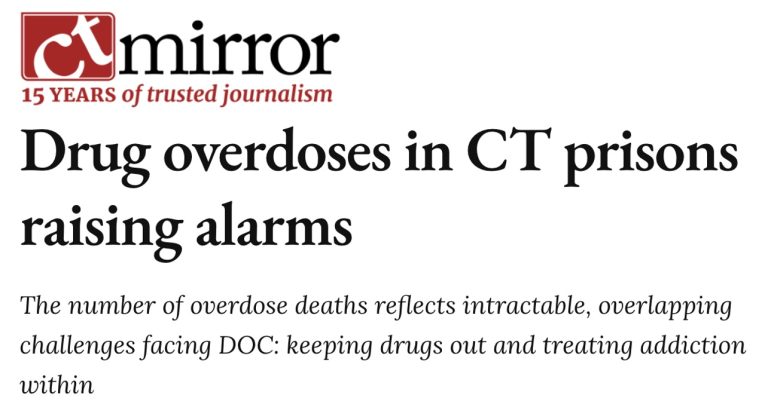
The Connecticut report, also from September of this year, also highlights the predictable role of medically dispensed opioids in overdose deaths in Connecticut prisons, where their dispensing has increased dramatically.
To address the pervasiveness of addiction in its facilities, the Department of Correction administers a program known as medication assisted treatment, or MAT. The program launched in 2013, when DOC began a pilot program at the New Haven Correctional Center.
MAT provides medication like methadone and buprenorphine, which suppresses withdrawal symptoms for people addicted to heroin or opiates. The program has expanded over the years, and as of last year some type of MAT existed in 10 of Connecticut’s 13 correctional facilities.
That’s 12 years of increasingly provided gold standard medical cure to high-risk opioid users. There must be some evidence of benefit from that, right?
There is, right? With evidence that any decreases in opioid-related deaths are NOT due to differential provision and proximity of subjects released to treatment, medical, and community services and supports resulting in higher probability of naloxone reversals of overdose = high-risk use? That type of necessary evidence?
Each facility has a supply of the anti-overdose medication naloxone and at least one substance abuse counselor, who offers counseling to people in the facility who are struggling with substance use.
But incarcerated people in Connecticut prisons are dying from overdoses often from controlled substances they were prescribed. …
While many of the overdose deaths in the last three years in the Department of Correction were the result of overdoses on street drugs, Tyler Cole’s case was different. According to the medical examiner, Cole’s death was from a combination of methadone and antipsychotic drugs he was prescribed, which was being administered while he was at Garner. …
Just two days before Cole’s death, on July 19, 2024, 30-year-old Ronald Johnson also died of a methadone overdose at Garner. Johnson had been transferred to Garner from Riker’s Island prison in New York.

Naloxone, its days numbered, may be saving lots of lives, but is no match for the harm from maleficent, lethal disregard by America’s expert/media collusion.