VALID MEASURES OF A WORSENING OPIOID CRISIS: WITH SUPPLY CHANGES, RISKIER USE AND MORE OVERDOSES IN ARIZONA
As elsewhere, generally, gold standard treatment failure generates increasing high-risk use, while Narcan campaigns hide the mounting overdoses and deaths. And users adjust continuing use, with increasing risk, to supply disturbances.
by Clark Miller
Published March 20, 2026

Combs’ stepfather was one of more than 5,000 people who overdosed in Maricopa County last year, according to data from the city of Phoenix and the Arizona Department of Health Services. What’s more, the numbers are going in a distressing direction. There were more suspected overdoses per month last year than there were from 2022 to 2024, according to Phoenix’s Office of Public Health. There were 4,258 suspected overdoses in 2024, but 2025 saw a whopping 5,942. Overdose death totals kept by the Arizona Department of Health Services are incomplete for 2025 — DHS blames a data issue — but the department reported more than a thousand overdose deaths in Maricopa County in 2024.
This is a unique case across the country. Arizona remains one of only a few states to have had an increase in overdoses, as a national decline of overdose deaths occurred in 2025, according to the Centers for Disease Control and Prevention.
[emphasis added]
The New Times piece is notably well done and important, describing a researcher’s observations of what is happening on the streets, in Phoenix’s economies and ecologies of high-risk, illicit opioid use – we’ll get to that soon.
But that conflation in the excerpt above is profoundly and dangerously off and misleading, that Arizona is
“a unique case across the country. Arizona remains one of only a few states to have had an increase in overdoses, as a national decline of overdose deaths occurred in 2025, according to the Centers for Disease Control and Prevention.
There are few distinctions more important in understanding the true course and nature of the worsening crisis than that between the meaning and import of differences and changes in nonfatal opioid overdoses versus fatal, treated as essentially equivalent or at least covarying, in the unfortunate paragraph.
That’s all covered and established in numerous posts here, for example recently here.
Short version: it’s established that 1) naloxone use and campaigns have always confounded the meaning of fatal opioid overdose trends, naloxone accounting for all recent drops, nullifying claims of gains against the crises attributable to treatments or other factors, and 2) that increasingly under-reported and undercounted, nonfatal opioid overdoses of course represent instances of high-risk opioid use, therefore gold standard treatment failure. They are, as in Arizona, increasing everywhere, consistently, as evidenced partly by necessity, increasingly, of widespread, intensive, emergency, highly-resourced naloxone campaigns to moderate effects of that increasing high-risk use. The evidence for those established trends and their meaning are repeatedly provided in related posts.
So, the increasing prevalence of high-risk opioid use and overdose in Arizona, and everywhere else, mean something important.
It’s another consistent sign and example of decades-long failure of expert gold-standard “treatments” for the crisis.
And it points to the remarkably desperate extent to which America’s expert/media collusion has gone to attempt to mystify and cover that failure by concocting ungrounded stories to explain drops in fatal opioid overdoses – including that deaths have decreased due to fentanyl supply disruptions, or “supply shock“.
To dismantle and nullify that popularized cover story, it is enough to simply note that supply disruptions can affect opioid overdose deaths only by changing the prevalence of high-risk use and reducing overdoses. But opioid overdoses are not decreasing, instead increasing, as in Arizona.
An independently nullifying deconstruction of opioid “supply shock” effects is outlined in the news piece we are considering.
Why is the opioid problem in Phoenix getting worse? One reason, Raminta Daniulaityte says, has to do with the stuff on the street.
Daniulaityte is a professor at Arizona State University’s College of Health Solutions. In June, she co-authored a study published in the International Journal of Drug Policy that examined Phoenix’s opioid crisis through the lens of fentanyl pills.
She interviewed drug users, the majority of whom said that fentanyl powder is known to be “significantly more dangerous” than illicitly manufactured fentanyl pills. Despite that, fentanyl powder has become more common on the street as the potency of the pills has waned.
“People are not getting what they need from (the pills),” Daniulaityte said.
That matches what the Arizona branch of the Drug Enforcement Administration has seen. In Arizona, the DEA saw a 79% increase in seizures of fentanyl powder between 2024 and 2025. Cheri Oz, the special agent who led the DEA’s Phoenix field office last year, said that many drug users are turning to powder to maintain their habit, leading to extreme variance in dosage.
Many participants in Daniulaityte’s study were aware of the dangers of fentanyl powder — “Almost like you playin’ Russian Roulette when you’re smokin’,” one man told researchers — but that risk gets overlooked when addiction persists.
The DEA reports that the potential lethal dosage of fentanyl pills has decreased from eight out of 10 being fatal to only three out of 10, but that has resulted in users taking more pills to feel the same effects or resorting to powder, which is harder to precisely dose.
“The opioid dependent community is ingesting more pills, knowing that the potency has gone down and that the recipes have changed a little bit on the Sinaloa side of the manufacturing,” Oz said. “If you’re taking more, if you get one hot pill in your mix, that could likely cause an overdose.”
But Oz is more concerned about carfentanil, a synthetic opioid that the DEA says is 100 times more dangerous than fentanyl itself.
Last March, the DEA saw an influx of carfentanil in the Arizona market, which Oz called an “anomaly.” In May, the agency put out a nationwide alert warning about the surge of carfentanil, which is so potent that it’s known to require more than one dosage of naloxone to reverse an overdose.
“Fentanyl scares me,” Oz said. “Carfentanil keeps me up at night.”
[emphasis added]
There are no surprises here. The behaviors described have always been known for highly dependent, high-risk opioid and other substance users – intently focused, determined, successful efforts to seek, find, and use closest substitutes and alternatives to the “drug of choice”, the substance that has been providing the desperately needed temporary relief from inner distress, fear of distress, and fear of facing the psychic/emotional roots of distress.
We saw it in Baltimore, where opportunistic use of risky, unknown, purportedly opioid samples led to a mass overdose event, followed 8 days later by a similar instance of desperately indiscriminate use of an unreliable supply, and repeated for a third time within 3 months.

Reported here, Baltimore’s mayor conveyed the situation as,
Mayor Brandon Scott is pleading with residents who consume drugs to do so as safely as possible.
“For everyone in Baltimore, we understand that the supply across the city is very volatile right now,” he said during a press conference in Penn North. “I want everyone to hear me. Hear me very clearly. If you see someone who may be overdosing, help them.”
[emphasis added]
That’s an admirable, valuable, and seemingly sincere sentiment and message.
Just not the way it’s working on the street.
Not anywhere.
That lethal, harm-predicting, confused, thought-free media conveyance of medical misinformation oblivious to the meaning of trends for nonfatal versus fatal opioid overdoses in the Phoenix New Times piece is taken to new heights of incompetent and lethally confused discussion here, in a more recent local news piece from KJZZ Phonenix (not coincidentally, it seems, an NPR affiliate), in which the headline and following copy, the interviewer, and the medical expert “addiction doctor” repeatedly demonstrate a profoundly diminished grasp of those important distinctions. It’s worth a read.
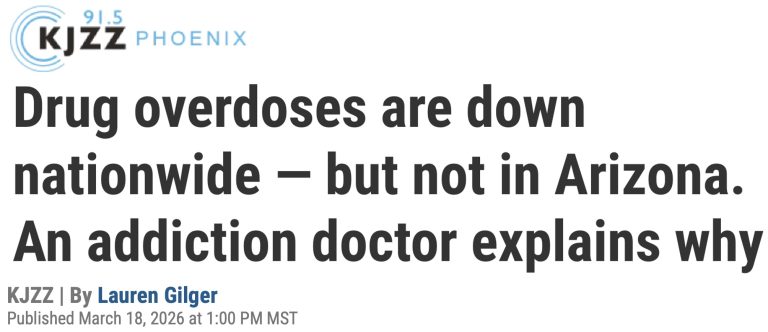
Accidentally in that NPR news report, by the cumulative meaning added by relayed collateral reports of direct service workers who see and understand the forces shaping high-risk illicit opioid use in those economies in Arizona, the accurate picture emerges. As in communities in Maine and other states and locales, consistently, whatever gains have been provided against lethal medical gold standard treatment by naloxone campaigns reducing deaths, the dispersions and disruptions of tightly functioning and self-preserving homeless and other communities of high-risk users, proximate to each other and providing Narcan reversals effectively when seconds count, are predictably lethal, as are increasingly grave shifts in potency of street drug adulterants and substitutes, overwhelming the reliability of naloxone to keep up with the predictably mounting high-risk use generated by expert treatments that have been failing for decades.
Faced with challenges in getting what they desperately need, in persistently variable and unstable street economies of illicit opioid use, dependent opioid users do not simply give up, do not stop using and remain avoidant of use indefinitely, instead redouble their efforts at higher risk. That’s clear.
Yet, that is exactly what must happen for “supply shock” or any form of supply disruption to have death-reducing effects, first by stopping high-risk use. The necessary fabrication conveying that those effects have been happening and contributing to drops in opioid fatal overdoses is absurd on its face, that distracting deception and absurdity explored further in an upcoming post:
“THE LETHAL ROLE OF ABDICATION OF THOUGHT IN A WORSENING OPIOID CRISIS”
More to come.